
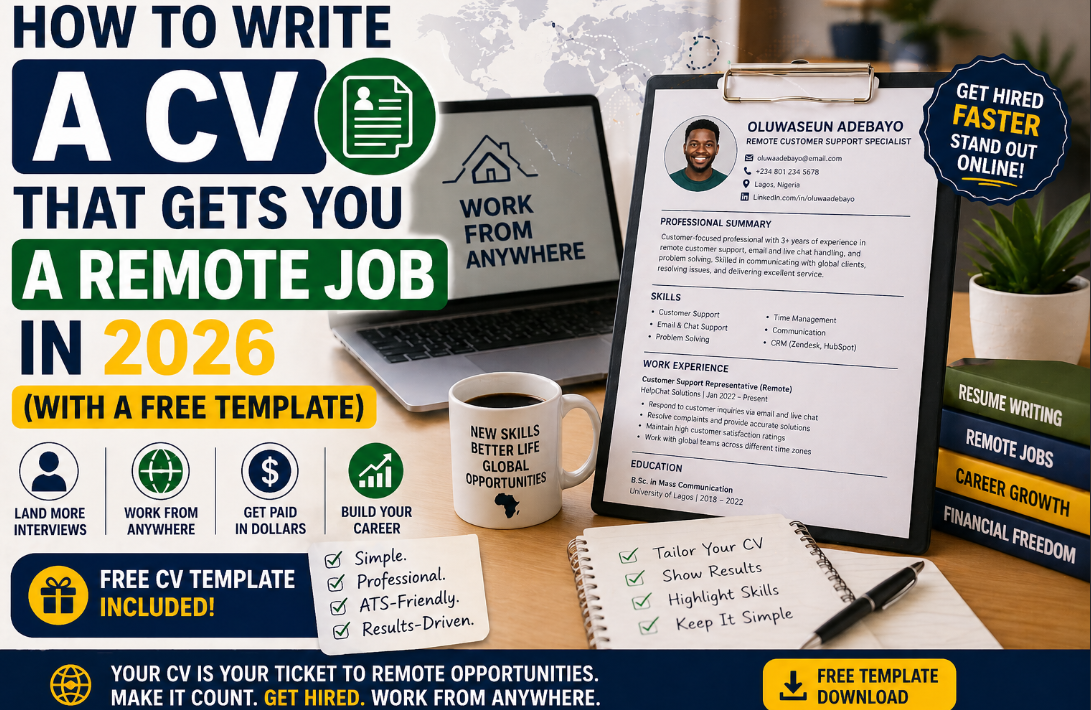
How to Write a CV That Gets You a Remote Job in 2026 (With a Free Template)
Your CV is doing one of two things right now. It is either opening doors or quietly closing them before you ever get a chance to speak to anyone.
Most CVs that get rejected are not rejected because the person was unqualified. They are rejected because the CV made it too hard for a recruiter to see the value the candidate brings. Poor formatting, vague descriptions, too much information, or too little of the right information, these are the real reasons applications go nowhere.
This guide is going to change that for you. By the end of it, you will know exactly what a strong remote-job CV looks like in 2026, what to include, what to leave out, how to write bullet points that actually impress recruiters, and you will have a complete free template you can copy, customise, and start using today.
Why Your CV Matters More for Remote Jobs
When you apply for a local job, a recruiter might give you the benefit of the doubt if your CV is a little rough; they can meet you in person and form their own impression. Remote hiring does not work that way.
For remote roles, especially those at international companies paying in dollars or pounds, your CV is often the only thing between you and a rejection. There is no office visit, no chance encounter in a corridor, no local reference network. What you submit is all they have.
This means your CV needs to do more work, and do it faster. Recruiters at international companies often spend less than 30 seconds on an initial CV scan. In that window, your CV either communicates clearly that you are worth a closer look, or it gets passed over.
The good news is that most of your competition is submitting mediocre CVs. A well-structured, clearly written, honest CV stands out immediately, even without years of experience.
The Basics: What a Remote Job CV Must Have in 2026
Before we get into the details, here are the non-negotiables:
One page for less than 5 years of experience. Two pages maximum for 5–10 years. If you have less than five years of experience and your CV is two pages, something is wrong — you are either including irrelevant information or not editing tightly enough.
No photo. Unless you are applying to a role in a country where photos are specifically requested (Germany, some parts of Asia), do not include your photo. International remote employers, particularly in the US and UK, do not want photos, and including one can accidentally introduce bias you do not want affecting your application.
No objective statement. “I am a hardworking, motivated individual seeking an opportunity to grow” tells a recruiter nothing. Replace it with a professional summary — two to three lines that say specifically who you are, what you do, and what kind of role you are targeting.
Clean, readable formatting. Use a single font (Calibri, Arial, or Georgia works well), consistent font sizes, and clear section headings. No tables with hidden borders that break when the recruiter opens your PDF. No columns that confuse applicant tracking systems (ATS). Simple and clean always beats creative and complicated.
Save as PDF. Always submit your CV as a PDF unless the application specifically asks for a Word document. PDFs preserve your formatting across all devices and operating systems.
Section by Section: What to Write and How
1. Your Name and Contact Information
At the very top. Large and clear. Include:
- Full name
- Professional email address (firstname.lastname@gmail.com, not nicknames or old school emails)
- Phone number with country code
- LinkedIn profile URL (if it is updated and professional)
- City and Country, you do not need your full home address
What to leave out: Date of birth, marital status, religion, nationality, state of origin. None of this is relevant to whether you can do the job, and including it can expose you to unconscious bias. International employers do not need or want this information.
2. Professional Summary (2–3 Lines)
This replaces the old “objective statement.” It should answer three questions in two to three sentences:
- Who are you professionally?
- What is your strongest relevant skill or experience?
- What are you looking for?
Weak example: “I am a motivated and hardworking graduate seeking a challenging role in a dynamic organisation where I can contribute my skills and grow professionally.”
Strong example: “Customer support professional with 2 years of experience resolving technical and billing issues for fintech customers. Skilled in Zendesk, live chat support, and cross-functional communication. Seeking a remote customer success role at a global technology company.”
The strong version is specific. It names tools. It names the type of role. It gives a recruiter immediate context. Write yours the same way.
3. Work Experience
This is the most important section of your CV. For each role, include:
- Job title
- Company name
- Location (City, Country — or “Remote” if it was remote)
- Dates (Month/Year — Month/Year)
- 3–5 bullet points describing what you actually did and achieved
The bullet point rule: Every bullet point should follow this structure: Action verb + what you did + the result or scale.
Weak bullet: “Responsible for handling customer complaints.”
Strong bullet: “Resolved an average of 45 customer support tickets daily via Zendesk, maintaining a 94% customer satisfaction rating over 12 months.”
The difference is specificity. Numbers, tools, outcomes — these are what make bullet points convincing. Not every bullet needs a number, but as many as possible should have one.
Action verbs to use: Managed, built, reduced, increased, led, designed, resolved, implemented, launched, trained, negotiated, analysed, automated, coordinated, delivered.
Action verbs to avoid: “Responsible for,” “Assisted with,” “Helped with” — these are passive and weak. Own what you did.
4. Education
List your most recent degree first. Include:
- Degree and field of study
- Institution name
- Year of graduation (or expected graduation)
- Grade or GPA — only if it is strong (Second Class Upper / First Class / 3.5+ GPA)
If you have a degree, your secondary school results do not need to be on your CV. If you are a fresh graduate with no work experience, you can expand this section slightly to include relevant coursework, final year projects, or academic achievements.
5. Skills
A clean, scannable list of your relevant technical and professional skills. Organise them into two or three categories if helpful:
- Technical skills: Tools and software you genuinely know (Salesforce, Excel, SQL, Figma, Zendesk, Slack, Jira, HubSpot, etc.)
- Professional skills: Communication, project management, data analysis, client relationship management, etc.
- Languages: If you speak multiple languages, list them with proficiency level
Only list skills you can actually demonstrate in an interview or on a test. If you put “advanced Excel” and a recruiter asks you to build a pivot table, you need to be able to do it.
6. Certifications and Training (Optional but Powerful)
If you have completed any relevant online courses or certifications — Google, Coursera, HubSpot, AWS, Cisco, Meta, Microsoft — list them here. For candidates without extensive work experience, certifications show initiative and signal that you are actively building skills. This section can genuinely compensate for a shorter work history.
7. Volunteer Work, Side Projects, or Freelance Experience
Many candidates skip this section and lose an opportunity. If you have:
- Managed a WhatsApp community or social media page
- Done freelance design, writing, or coding work
- Volunteered in an organising or coordination role
- Run any kind of informal business or project
These all count as experience. Frame them the same way you would a formal job — title, organisation or project name, dates, and bullet points with results.
What NOT to Include on Your CV
These are the things that actively hurt your application:
Your photo: discussed above. Leave it out for international applications.
“References available on request”: This takes up space and tells the recruiter nothing. Everyone has references available. Remove this line entirely.
Your primary or secondary school: Once you have a degree, your earlier schooling is irrelevant. Remove it.
Hobbies that add no value: “I enjoy reading and watching movies” does not strengthen your application. Only include interests if they are directly relevant to the role or genuinely distinctive (e.g., competitive chess, published writing, community leadership).
Every job you have ever held: Only include experience from the last 7–10 years, and only roles that are relevant to the position you are applying for. A CV that includes your 2013 internship and every temporary job since is too long and unfocused.
Soft skill claims without evidence: “I am a team player,” “I am detail-oriented,” “I am a fast learner” — every single candidate says this. It means nothing on a CV. Show these qualities through your bullet points instead of stating them directly.
ATS: The Invisible Filter You Need to Understand
Most international companies, especially those with high application volumes, use Applicant Tracking Systems (ATS) to filter CVs before a human ever sees them. ATS software scans your CV for keywords that match the job description and scores your application accordingly.
If your CV does not include the right keywords, it may never reach a recruiter, regardless of how qualified you are.
How to beat ATS:
Read the job description carefully and identify the specific skills, tools, and role responsibilities mentioned. Then make sure your CV uses the same language where it is honestly applicable. If the job description says “customer success” and your CV says “client support,” the ATS may not recognise them as equivalent, even though you mean the same thing.
Do not stuff keywords artificially. Use them naturally in your bullet points and skills section in ways that reflect your experience.
Use a clean, single-column layout. Multi-column CVs often confuse ATS parsing software and scramble your information before a human reads it.
Free CV Template: Copy and Customise or Access the doc here (Free CV Template)
Use this structure exactly. Replace every section with your own information.
[YOUR FULL NAME] [City, Country] | [your.email@gmail.com] | [+234 XXX XXX XXXX] | [linkedin.com/in/yourname]
PROFESSIONAL SUMMARY
[Your job title or field] with [X years] of experience in [your core skill area]. Proven ability to [key achievement or strength]. Seeking a [type of role] where I can [what you want to contribute].
WORK EXPERIENCE
[Job Title] | [Company Name] | [City, Country or Remote] | [Month Year – Month Year]
- [Action verb + what you did + result/scale]
- [Action verb + what you did + result/scale]
- [Action verb + what you did + result/scale]
[Job Title] | [Company Name] | [City, Country or Remote] | [Month Year – Month Year]
- [Action verb + what you did + result/scale]
- [Action verb + what you did + result/scale]
- [Action verb + what you did + result/scale]
EDUCATION
[Degree] in [Field of Study] | [University Name] | [Year of Graduation] [Grade/GPA — only if strong]
SKILLS
Technical: [List tools and software] Professional: [List relevant professional skills] Languages: [English — Fluent; others as applicable]
CERTIFICATIONS (if applicable)
[Certification Name] — [Issuing Organisation] — [Year] [Certification Name] — [Issuing Organisation] — [Year]
PROJECTS / FREELANCE / VOLUNTEER WORK (if applicable)
[Role or Project Title] | [Organisation or Project Name] | [Dates]
- [What you did and what it achieved]
CV Checklist Before You Submit
Run through this before sending any application:
- Is it one page (or maximum two for 5+ years of experience)?
- Does it have a specific professional summary — not a generic objective statement?
- Does every bullet point start with a strong action verb?
- Have I quantified at least half of my bullet points with numbers or outcomes?
- Have I removed my photo, date of birth, marital status, and state of origin?
- Have I checked for spelling and grammar errors?
- Have I tailored the skills section to match this specific job description?
- Is it saved as a PDF with a professional filename (FirstName-LastName-CV.pdf)?
- Have I removed “References available on request”?
- Have I used a clean, single-column layout with consistent fonts?
Now Apply: Remote Jobs Currently Open on This Site
You have the CV. Now use it. Here are remote and entry-level roles currently live on this site that are worth applying to:
- IT Support Officer at Kora — Remote Nigeria — Entry Level
- Support Engineer at Sourcegraph — Remote EMEA — $42,400 USD base
- Customer Success Manager at Sourcegraph — Remote — Dollar-paying
- Customer Success Engineer at Nash — Remote UK — GBP-paying
- YouTube Video Editor at Revero — Remote — Fully Remote
- Product Designer at CrowdRiff — Remote — Fully Remote
- Financial Growth Analyst at Roo — Remote US — Dollar-paying
View the full jobs board at jobs.iammagnus.com/jobs — updated daily with remote, entry-level, and international roles.
FAQ
Should I use the same CV for every job I apply to? No, and this is one of the most common mistakes candidates make. You should have one master CV and then tailor it slightly for each application by adjusting your professional summary and ensuring your skills section mirrors the language in the job description. The structure stays the same; the specifics change.
How do I write a CV if I have no work experience? Lead with education and expand it to include relevant coursework, final year projects, and academic achievements. Then include any internships, volunteer work, freelance projects, or community involvement. Frame all of it using the action verb + result structure. Everyone starts somewhere — the key is presenting what you have as clearly and compellingly as possible.
Should I include my NYSC experience on my CV? Yes, absolutely, if your NYSC placement involved relevant work. Treat it like any other job: job title, organisation, dates, and bullet points describing what you actually did. NYSC experience is work experience.
What font and font size should I use? Calibri, Arial, or Georgia at 10–11pt for body text, and 12–14pt for your name and section headings. Avoid Times New Roman (dated) and any decorative fonts.
How far back should my work history go? Generally, no further than 10 years. For most candidates under 30, list every relevant role you have held. For more experienced candidates, focus on the most recent and most relevant positions.
Do I need a cover letter as well? For most international remote applications — yes. A CV tells recruiters what you have done. A cover letter tells them why you want this specific role at this specific company and why you are the right fit. We will cover letter writing in a separate post shortly.
What is the best tool to build my CV? Google Docs is reliable, free, and produces clean PDFs. Canva has nice templates, but it can produce multi-column layouts that confuse ATS software — use it only if the role does not require ATS submission (which is rare). Microsoft Word is also fine. Avoid heavily designed infographic CVs for professional roles.

