
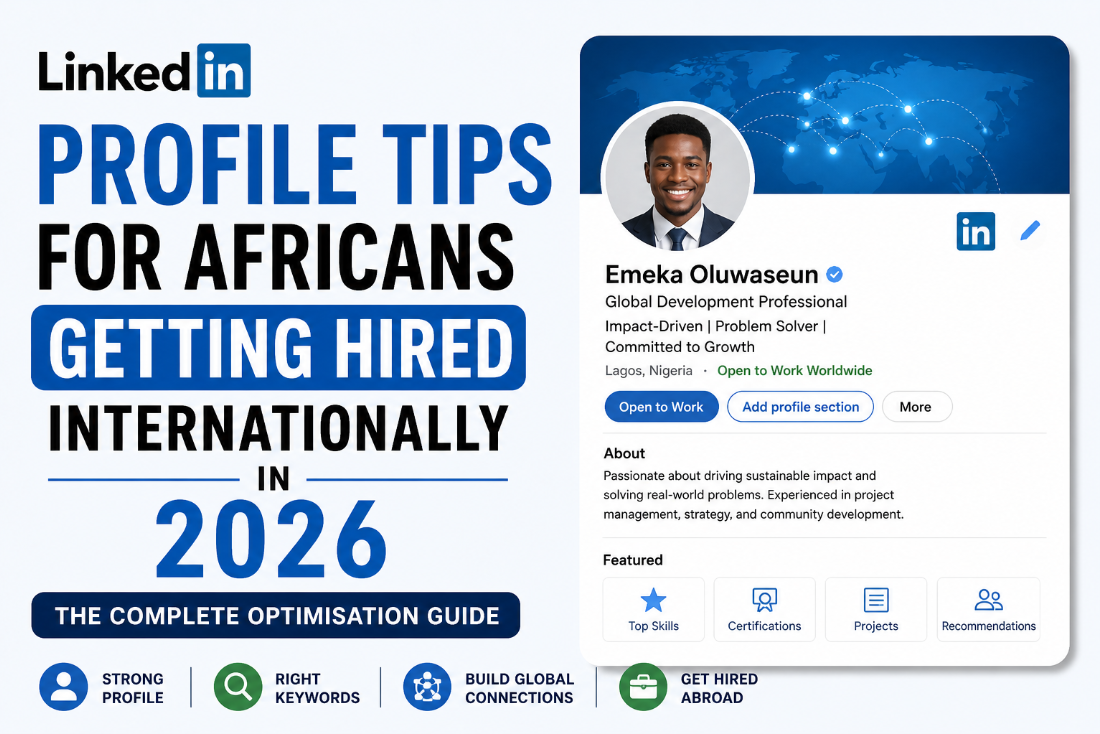
LinkedIn Profile Tips for Africans Getting Hired Internationally in 2026 — The Complete Optimisation Guide
LinkedIn is the single most important platform for getting noticed by international recruiters. And yet most African professionals are using it in a way that makes them nearly invisible to the people they most want to reach.
This is not about working harder on LinkedIn. It is about working differently. A few specific changes to how your profile is structured, written, and positioned can move you from invisible to actively sought-after, without paying for Premium, without gaming the algorithm, and without pretending to be someone you are not.
This guide covers every section of your LinkedIn profile, explains what international recruiters are actually looking for, and tells you specifically how to optimise each part for maximum visibility and impact.
Why LinkedIn Is Non-Negotiable for International Job Seekers
International companies, particularly US, UK, Canadian, and European companies hiring remotely, use LinkedIn differently from how most African professionals currently use it.
For these employers, LinkedIn is not just a place to post jobs. It is a sourcing tool. Recruiters actively search LinkedIn for candidates using specific keywords, filters, and Boolean search strings. If your profile is not structured with the right keywords in the right places, you will not appear in those searches, even if you are perfectly qualified for the role.
A well-optimised LinkedIn profile works for you 24 hours a day. While you sleep, recruiters in San Francisco, London, and Amsterdam are searching for people with your skills. The question is whether your profile is built to be found.
1. Your Profile Photo: First Impressions Before a Single Word
LinkedIn profiles with professional photos receive significantly more profile views than those without. For international job seeking, your photo communicates professionalism before any recruiter reads a word you have written.
What works: A clear, well-lit headshot where your face takes up at least 60% of the frame. Plain or simple background. Professional but not stiff, a natural, confident expression. Dress as you would for a professional meeting in your field.
What does not work: Group photos where you have cropped yourself out. Sunglasses. Heavily filtered photos. Casual photos from events. Very dark or blurry images. Phone selfies in informal settings.
You do not need a professional photographer. A well-lit photo taken by a friend against a plain wall, in good natural light, with a decent smartphone camera, is entirely sufficient.
2. Your Headline: The Most Important Line on Your Profile
Your LinkedIn headline appears everywhere your profile appears in search results, in recruiter searches, in connection suggestions, and in comment sections. It is the first text a recruiter sees, and it determines whether they click on your profile at all.
Most African professionals write their headline as their current job title and company:
“Customer Service Representative at Zenith Bank”
This is a missed opportunity. Your headline should not just describe where you are; it should signal what you do and who you help, using language that international recruiters search for.
Formula that works: [What you do] | [Who you help or what result you deliver] | [Key tools or specialisation]
Weak headline: “Customer Service Representative at Zenith Bank.”
Strong headline: “Customer Success Professional | Helping SaaS Companies Retain and Grow Client Revenue | Zendesk | Salesforce | Remote-Ready”
More examples:
Instead of: “Software Engineer at Interswitch,” Try: “Full-Stack Software Engineer | Node.js | React | Python | Open to Remote Opportunities.”
Instead of: “Marketing Officer at MTN Nigeria” Try: “Digital Marketing Specialist | SEO | Paid Media | Content Strategy | B2B and B2C Growth.”
Instead of: “Finance Analyst” Try: “Financial Analyst | FP&A | Excel | Power BI | Helping Businesses Make Data-Driven Decisions.”
The keywords in your headline directly affect whether you appear in recruiter searches. Use the language that appears in job descriptions for roles you want — not the internal titles your current company uses.
3. Your About Section: Your Story, Not Your CV Summary
The About section is the most underused part of most African professionals’ LinkedIn profiles. Many either leave it blank or paste a formal third-person biography that reads like a press release.
International recruiters read About sections to understand who you are as a person and professional, not to get a repeat of your work history. Write it in the first person. Make it human. Make it specific.
Structure that works:
Opening line: A single sentence that captures what you do and what drives you. Make it specific enough to be interesting.
What you do: Two to three sentences on your core expertise, the specific problems you solve, and the type of work you are best at.
What you have achieved: Two to three specific accomplishments with numbers where possible.
What you are looking for: A clear statement of the kind of opportunities you want, remote, international, specific industries, or company types.
How to reach you: End with an invitation to connect or message.
Weak About section: “I am a hardworking and dedicated professional with experience in customer service and operations. I am a team player who is passionate about delivering excellent service and contributing to organisational growth. I am currently seeking new opportunities where I can utilise my skills.”
Strong About section: “I spend my days making sure customers actually succeed with the products they pay for, not just use them, but get genuine value from them.
Over the last four years, I have built customer success processes for two fintech companies, reducing churn by an average of 28% and increasing NPS scores from 32 to 61 at my most recent role. I work best in fast-moving environments where the customer experience is still being figured out — the kind of place where building the right systems from scratch actually matters.
I am actively looking for remote customer success roles at B2B SaaS companies where I can bring both strategic thinking and hands-on execution. I am based in Lagos (GMT+1), work well asynchronously, and have a home office setup built for reliable remote collaboration.
If you are hiring for customer success or want to talk about building retention systems that actually work, send me a message.”
4. Your Experience Section: Write For Recruiters, Not HR Systems
Most people write their LinkedIn experience section the same way they write a job description, listing responsibilities rather than achievements. Recruiters at international companies are not interested in what your job was supposed to involve. They want to know what you actually did and what resulted from it.
For every role, apply the same rule as your CV: Action verb + what you did + result or scale.
Weak experience bullet: “Responsible for managing customer accounts and resolving complaints.”
Strong experience bullet: “Managed a portfolio of 65 SME accounts, resolving escalated complaints within 4 hours on average and maintaining a 94% satisfaction score over 12 months.”
Also, critically use keywords from international job descriptions in your experience section. If the roles you want mention “customer success,” “account management,” “retention,” “onboarding,” “churn reduction”, make sure those exact terms appear in your experience where they honestly reflect your work.
5. Your Skills Section: Strategic, Not Exhaustive
LinkedIn allows you to list up to 50 skills. Most people either list too few or list random skills with no strategic logic.
The skills section affects LinkedIn’s search algorithm. Recruiters filter candidate searches by skill. If “Zendesk,” or “SQL,” or “HubSpot” is not in your skills section, you may not appear in searches where those tools are required.
How to choose your skills strategically:
Open five to ten job descriptions for roles you want. Make a list of every skill, tool, and competency mentioned. Then add the ones that honestly reflect your experience to your LinkedIn skills section.
Get endorsements for your top three to five skills from colleagues or managers. Endorsed skills carry more weight in LinkedIn’s ranking algorithm than unendorsed ones.
Pin your three most important skills to the top of your skills section — these are the ones that appear above the fold before someone clicks “show all.”
6. The “Open to Work” Feature: Use It Strategically
LinkedIn’s Open to Work feature signals to recruiters that you are available. Used correctly, it is a powerful visibility tool. Used carelessly, it can create unnecessary complications with your current employer.
If you are currently employed and job searching quietly, use the “Share with recruiters only” setting. This makes your Open to Work status visible to recruiters without displaying the green “Open to Work” banner publicly on your profile.
If you are openly job searching: The public banner increases your visibility in recruiter searches and signals availability clearly.
In your Open to Work settings, be specific: List the exact job titles you are targeting, your preferred locations (include “Remote” explicitly), and your start date availability. Vague settings produce vague results.
7. Your Location: Set It Strategically
Many African professionals set their LinkedIn location to their city and country, “Lagos, Nigeria” or “Nairobi, Kenya”, and leave it at that. There is nothing wrong with this, but it is worth knowing that some international recruiters filter searches geographically and may exclude locations they perceive as logistically complicated.
You have options here. You can keep your accurate location and address the remote question proactively in your headline and About section. Or, if you are genuinely targeting roles in a specific geography and are willing to relocate, you can set your location to that city.
What matters most is that your headline and About section clearly communicate your remote availability and your time zone — this addresses the practical concern behind any location filtering far more effectively than changing your listed city.
8. Your Connections: Quality Over Quantity, But Volume Matters Too
LinkedIn’s algorithm gives more visibility to profiles with more connections. Specifically, once you pass 500 connections, your profile displays “500+” rather than the exact number, a signal to recruiters that you are an established professional with a real network.
Priority connections to build:
- People in roles you aspire to, especially at companies you want to work at
- Recruiters at international companies or recruitment agencies that specialise in your field
- Alumni from your university who are working in international or remote roles
- Former colleagues, managers, and collaborators
When sending connection requests, always include a brief personalised note — even a single sentence that explains why you are connecting. This dramatically increases your acceptance rate compared to blank connection requests.
9. LinkedIn Activity: The Part Most People Ignore
A complete, optimised profile is the foundation. But the profiles that get the most recruiter attention are the ones that are active.
You do not need to post every day. But consistent, relevant activity signals to LinkedIn’s algorithm, and to anyone who visits your profile, that you are engaged, thoughtful, and present in your professional community.
What to post:
- Insights from your work, what you are learning, problems you are solving, and approaches that work
- Commentary on developments in your field, show that you follow your industry
- Stories from your professional experience, specific situations with a lesson or observation
- Honest takes on job searching, career development, or professional challenges
What not to post:
- Motivational quotes with no original thought attached
- Content that is political or divisive
- Complaints about your current employer or the job-searching process
- Anything you would not want a potential employer to read
One genuinely thoughtful post per week is more valuable than five generic ones. Write in your own voice. Be specific. Be honest. Posts that share a real perspective or a real lesson consistently outperform inspirational platitudes.
10. Recommendations: Social Proof That Moves Applications Forward
Written recommendations from former managers, colleagues, or clients are among the most compelling profile elements for international recruiters. They provide independent verification of what your profile claims about you.
Ask for recommendations from people who can speak to specific work — not just character. A recommendation that says “John is a wonderful person and a hard worker” adds little. One that says “Chioma redesigned our entire onboarding sequence, reducing time-to-value for new clients by three weeks and dropping 90-day churn by 18%” is genuinely persuasive.
Ask two to three people you have worked with closely to write you a recommendation. Make it easy for them — remind them of a specific project or achievement you worked on together and suggest they focus their recommendation around that.
Your LinkedIn Optimisation Checklist
Run through this before you start applying for international remote roles:
- Professional headshot with a clear, well-lit face
- Headline uses keywords from target job descriptions, not just your job title
- About section is written in the first person, specific, and ends with a clear call to action
- Experience bullets use action verbs and include numbers and outcomes
- Skills section includes keywords from international job descriptions in your field
- Open to Work setting is active with specific job titles and “Remote” listed
- Location settings and About section address remote availability clearly
- At least 500 connections — actively building toward this if not there yet
- Posting at least once per week with original, specific professional content
- At least two written recommendations from former managers or colleagues
FAQ
Do I need LinkedIn Premium to get hired internationally? No. LinkedIn Premium gives you access to InMail credits and some additional search data, but a well-optimised free profile outperforms a poorly optimised Premium one every time. Build your profile first. Premium is optional.
Should I connect with recruiters I do not know? Yes — with a brief personalised note. Connecting with recruiters at companies you want to work for, or at agencies that specialise in your field, is one of the most direct ways to get your profile in front of the right people.
How often should I post on LinkedIn? Once a week is a sustainable and effective frequency for most people. Consistency matters more than volume.
Is it okay to show my Nigerian or African location on LinkedIn? Yes, and address the remote question proactively in your headline and About section. Hiding your location rarely helps and can create awkward conversations later. Confidence about your location, combined with clear remote readiness, is a stronger position.
What should I do if I have no LinkedIn connections yet? Start with people you know, former classmates, colleagues, lecturers, and family members who are professionals. Then begin sending personalised connection requests to people in roles and industries you want to move into. Building from zero takes time, but is entirely achievable within a few months of consistent effort.
Can LinkedIn get me a job without me applying anywhere? Yes — inbound recruiter interest is real for well-optimised profiles. It is not guaranteed and should not replace active applications, but candidates with strong profiles in in-demand fields regularly receive unsolicited recruiter messages. Build your profile well and treat inbound interest as a bonus, not a strategy.

