
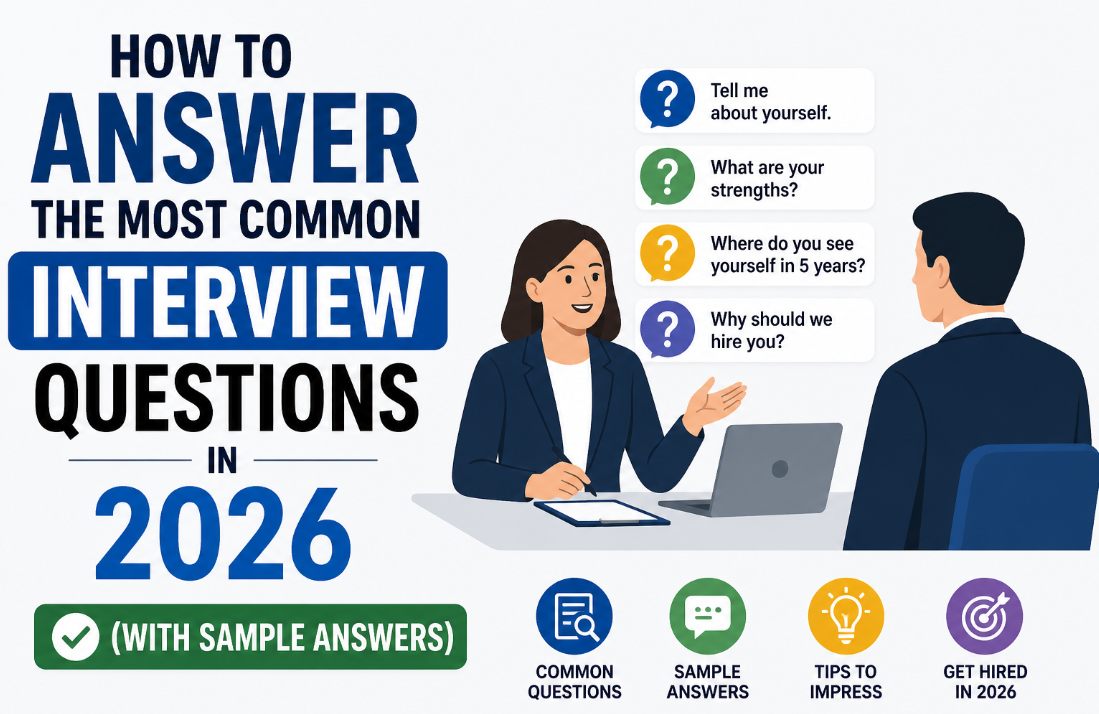
How to Answer the Most Common Interview Questions in 2026 (With Sample Answers)
The interview is the moment everything either comes together or falls apart. Your CV got you in the room or on the call. Now the job is yours to win or lose based on how you handle the next 30 to 60 minutes.
Most people prepare for interviews by thinking about what they might say. The best candidates prepare by thinking about what the interviewer is actually trying to find out, and then crafting answers that address that directly.
I am a recruiter and have been interviewing and hiring people for more than 6 years. I have interviewed over 3,000 candidates in over 35 countries. I will share with you a few tips that help you land your dream role.
This guide covers the most common interview questions asked at companies worldwide, explains what each question is really trying to uncover, from someone who has sat on the other side of the table thousands of times, shows you what a weak answer looks like versus a strong one, and gives you sample answers you can adapt to your own experience.
The Framework Behind Every Good Interview Answer (STAR)
Before we get into individual questions, here is one tool I have seen separate strong candidates from weak ones more consistently than anything else.
STAR stands for:
- Situation — Set the scene. Where were you, and what was the context?
- Task — What was your specific responsibility or challenge?
- Action — What did you specifically do? Not the team, you.
- Result — What happened as a result of your actions? Quantify where possible.
In over 3,000 interviews, candidates who answered behavioural questions using a clear STAR structure were consistently easier to evaluate, more credible, and more memorable than those who rambled or spoke in generalities. A STAR answer takes 60 to 90 seconds to deliver verbally. Use it for every “Tell me about a time when…” question you face.
The Questions, What They Are Really Asking, and How to Answer Them
1. “Tell Me About Yourself.”
What I am actually trying to find out: Give me a 90-second summary of your professional story that helps me understand who you are and why you are sitting in front of me today.
This is almost always the first question. After 6 years of interviews, I can tell within the first 60 seconds whether a candidate has prepared seriously or showed up hoping to wing it. This question is not an invitation to narrate your entire life history. It is your opportunity to deliver a focused, confident professional summary that sets the tone for everything that follows.
Structure to use:
- Where you started (briefly)
- What you have built since (your most relevant experience)
- Where you are headed (why this role, why now)
Weak answer: “I grew up in Lagos and went to university where I studied Business Administration. After graduating, I worked at a few companies and gained experience in different areas. I am now looking for a new opportunity where I can grow and contribute my skills.”
I have heard versions of this answer hundreds of times. It tells me nothing useful and signals low preparation.
Strong answer: “I have spent the last four years in customer success roles, most recently at a fintech company where I managed a portfolio of 80 SME clients and grew retention by 22% over 18 months. Before that, I built my foundation in client-facing support at a telecoms firm, which taught me how to handle high-volume, high-pressure customer interactions. I am now looking to take that experience into a remote-first environment where I can work with a more global client base, which is exactly what drew me to this role.”
That answer tells me who you are, what you have achieved, and why you are here. That is exactly what I need to know.
2. “What Is Your Greatest Strength?”
What I am actually trying to find out: What do you do better than most people, and is it relevant to this job?
The mistake I see constantly: Candidates choose a strength that sounds impressive but is vague, “I am a hard worker,” “I am a good communicator,” “I am a fast learner.” I have heard these phrases so many times that they have lost all meaning. They tell me nothing about you specifically.
Strong approach: Name one specific strength, give a brief example that demonstrates it, and connect it to the role.
Strong answer: “My strongest skill is breaking down complex problems into clear, actionable steps. At my previous role, we were losing clients at the onboarding stage, about 30% would disengage in the first 60 days. I mapped the entire onboarding journey, identified three specific friction points, and redesigned the touchpoint sequence. Churn in the first 60 days dropped by half within one quarter. That kind of structured problem-solving is something I bring to every challenge I work on, and I think it would be directly useful in this role given the onboarding challenges you mentioned.”
When I hear an answer like that, I write a note. When I hear “I am a hard worker,” I move on.
3. “What Is Your Greatest Weakness?”
What I am actually trying to find out: Are you self-aware enough to recognise your limitations, and are you actively working on them?
This question trips up more candidates than almost any other. In my experience, people either give a fake weakness disguised as a strength, “I work too hard,” “I am a perfectionist,” or they confess something genuinely disqualifying. Both are wrong.
The fake weakness is the one that frustrates me most as a recruiter. When a candidate says, “I am a perfectionist,” I know immediately they have not prepared an honest answer. It signals low self-awareness, which is a bigger red flag than whatever real weakness they are hiding.
The right approach: Choose a real weakness, honest but not fatal to the role, and show what you are actively doing to address it.
Strong answer: “Public speaking used to be a genuine weakness for me. I would over-prepare and still feel anxious presenting to groups. I recognised this was limiting me professionally, so over the last year, I joined a Toastmasters group and volunteered to lead two all-hands presentations at work. I am not going to claim it is now my strongest skill, but I have made measurable progress, and I no longer avoid opportunities that require presenting.”
That answer shows honesty, self-awareness, and initiative, three things I am always looking for.
4. “Why Do You Want to Work Here?”
What I am actually trying to find out: Have you done your research, and do you actually want this specific job, or are you applying everywhere and hoping something sticks?
I can always tell when a candidate has not researched the company. The tell is a generic answer that could apply to any employer in the world. After 3,000 interviews across 35 countries, this remains one of the most common reasons candidates fail at the shortlisting stage.
Strong approach: Reference something specific about the company, their product, a recent development, their mission, or a problem they are solving, and connect it to your own experience or values.
Strong answer: “What draws me specifically to this company is the way you have approached the SME lending gap in emerging markets. I have spent three years working in fintech and watched traditional banks consistently fail small business owners at the exact moment they need capital. The fact that your approval rate for first-time borrowers is three times the industry average tells me your credit model is actually working differently, not just in marketing materials but in outcomes. That is the kind of mission I want to be building toward.”
When a candidate says something that specific, I know they did their homework. That matters to me.
5. “Why Are You Leaving Your Current Job?”
What I am actually trying to find out: Are you running away from something, or running toward something? And will you speak negatively about us someday, too?
Never speak negatively about your current or previous employer in an interview. I have seen this end otherwise strong applications immediately. Even if your manager was difficult or the culture was toxic, an interview is not the place for that conversation. When candidates criticise former employers, I always wonder what they will say about us.
Strong approach: Frame your answer around growth, new challenges, or a natural next step, not what you are escaping.
Strong answer: “I have genuinely enjoyed my time at my current company and learned a great deal, particularly around scaling customer success operations. But I have reached the ceiling of what is available to me there in terms of scope and responsibility. This role offers the chance to work with a larger client portfolio, across multiple markets, and with a team that is building something at a stage where I can have real impact. That is the direction I want to grow in.”
That answer is honest, positive, and forward-looking. It gives me no cause for concern.
6. “Where Do You See Yourself in Five Years?”
What I am actually trying to find out: Are you ambitious enough to grow, grounded enough to be realistic, and likely to stay with us long enough to justify the investment of hiring and training you?
Weak answer: “In five years, I see myself in a senior management position, leading a team and contributing to the company’s growth.”
I have heard some version of this in roughly 70% of interviews. It is vague, self-serving, and tells me nothing about whether you have actually thought about your career or how it connects to this role.
Strong answer: “In five years, I want to be a recognised expert in customer success operations, specifically in building systems that scale retention across high-growth product companies. I see the next two to three years as the right time to deepen my expertise in a hands-on senior role, and from there, I would like to move into a leadership position where I am developing other CSMs as well as managing the function. I am attracted to this company specifically because the growth trajectory here seems like the right environment to develop that depth.”
Specific. Credible. Connected to the role. That is what I want to hear.
7. “Tell Me About a Time You Failed.”
What I am actually trying to find out: Can you take ownership of your mistakes? Do you learn from them? Are you honest enough to be trusted?
This question requires genuine self-disclosure. A candidate who cannot name a real failure either lacks self-awareness or is being dishonest, and I find out which one it is fairly quickly. Use STAR. Choose a real failure. Take clear ownership. Show what you learned and how you changed.
Strong answer: “Early in my career, I led a product launch for a new feature and missed a critical user testing step because we were under time pressure and I convinced myself we had enough data from internal testing. The feature launched with a UX flaw that a significant portion of users found frustrating, and we had to roll back within two weeks. What I learned — and genuinely internalised — is that time pressure is exactly when you most need to protect your testing process, not cut it. Since then, I have built a non-negotiable user testing gate into every project I lead, even when stakeholders push back on timelines.”
I respect candidates who can tell that story clearly and without deflecting blame. It tells me they are honest, and they grow from experience.
8. “Tell Me About a Time You Worked in a Difficult Team Situation.”
What I am actually trying to find out: Can you handle interpersonal conflict professionally? Do you collaborate effectively under pressure?
Strong answer: “In a previous role, I was part of a cross-functional team working on a product integration. Midway through, there was significant tension between the engineering and marketing leads about priorities; marketing wanted features that engineering considered technically risky, and neither side was willing to move. I was not the most senior person in the room, but I proposed a structured session where both sides mapped their requirements against user impact data. Getting the conversation onto shared evidence rather than opinion shifted the dynamic. We landed on a phased approach that satisfied both sides and delivered on time. What I took from that is that most team conflicts are rooted in people optimising for different things — surface the shared goal and the conflict usually shrinks.”
That answer shows initiative, emotional intelligence, and practical problem-solving. Those are exactly the qualities I am looking for in a strong candidate.
9. “What Are Your Salary Expectations?”
What I am actually trying to find out: Are you going to cost more than we have budgeted? And do you know your market value?
As a recruiter, I will tell you honestly, this question is uncomfortable for candidates, but it does not need to be. Research market rates for the role before the interview. Know your number. Be ready to state it clearly.
Strong approach: Give a range based on market research, explain briefly what informs it, and signal genuine flexibility on the full package.
Strong answer: “Based on my research into market rates for this role and my level of experience, I am targeting a range of $X to $Y. That said, I am also factoring in the full compensation package, including benefits, flexibility, and growth opportunities, so I am open to discussing what works within your structure.”
Candidates who have done this research are always easier to work with in the offer stage. Those who have not prepared a number lose negotiating ground immediately.
10. “Do You Have Any Questions for Us?”
What I am actually trying to find out: Are you genuinely interested in this role and this company? Have you thought seriously about whether this is the right fit for you?
I will be direct: “No, I think you have covered everything” is one of the weakest ways to end an interview. In my experience, candidates who ask no questions are almost never the ones who get the offer. It signals passivity and low genuine interest.
Always have three to five prepared questions. Ask two or three. Choose questions that show you have thought about the role seriously and are evaluating the company as much as they are evaluating you.
Strong questions I always appreciate hearing:
- “What does success look like in this role in the first 90 days?”
- “How would you describe the culture of this team specifically, not the company broadly?”
- “What do the strongest performers in this role have in common?”
- “What opportunities are there for growth beyond this position?”
When a candidate asks thoughtful questions, it tells me they are serious. When they ask none, I already know the answer I am going to give them.
Before Every Interview, A Preparation Checklist
- Research the company, what they do, their recent news, their product, and their mission
- Research the role, read the job description carefully, and map your experience to it
- Prepare three to five STAR stories covering leadership, problem-solving, failure, collaboration, and achievement
- Know your salary range based on market research
- Prepare five questions to ask at the end
- Test your technology, including a video interview, camera, microphone, background, and internet connection
- Dress appropriately, even for video interviews, dress as you would for an in-person meeting
- Be somewhere quiet with no interruptions for the duration of the interview
FAQ
Should I memorise my answers word for word? No, and as a recruiter, I can always tell when someone is reciting a memorised script. It sounds robotic and falls apart the moment I ask a follow-up. Prepare your key stories and bullet points, then speak naturally from that foundation.
How long should my answers be? Most answers should be 60 to 90 seconds for behavioural questions and 30 to 45 seconds for direct questions. If you are going much longer than two minutes on any single answer without being asked to elaborate, you are losing the interviewer’s attention, and I say that from experience on both sides of the table.
What if I do not have experience that matches the question? Draw on transferable experience, academic projects, volunteer work, freelance work, or situations from your personal life that demonstrate the same qualities. Be honest about the context while making the connection clearly.
Is it okay to take notes into an interview? Yes, particularly for video interviews. Having a notepad with your key stories, your prepared questions, and the job description in front of you is professional, not a cheat sheet.
What do I do if I do not know the answer to a question? Say so honestly and briefly, then pivot to what you do know. “I have not directly managed that kind of situation, but here is how I would approach it based on my experience with something similar…” is far better than bluffing. Recruiters notice bluffing every time.
What is the single most important thing I can do to prepare? Know your own stories. The candidates who impress me most are the ones who can speak specifically and confidently about their own experience — not the ones who have the cleverest answers to hypothetical questions. Know what you have done, what resulted from it, and how to communicate it clearly. Everything else follows from that.

