
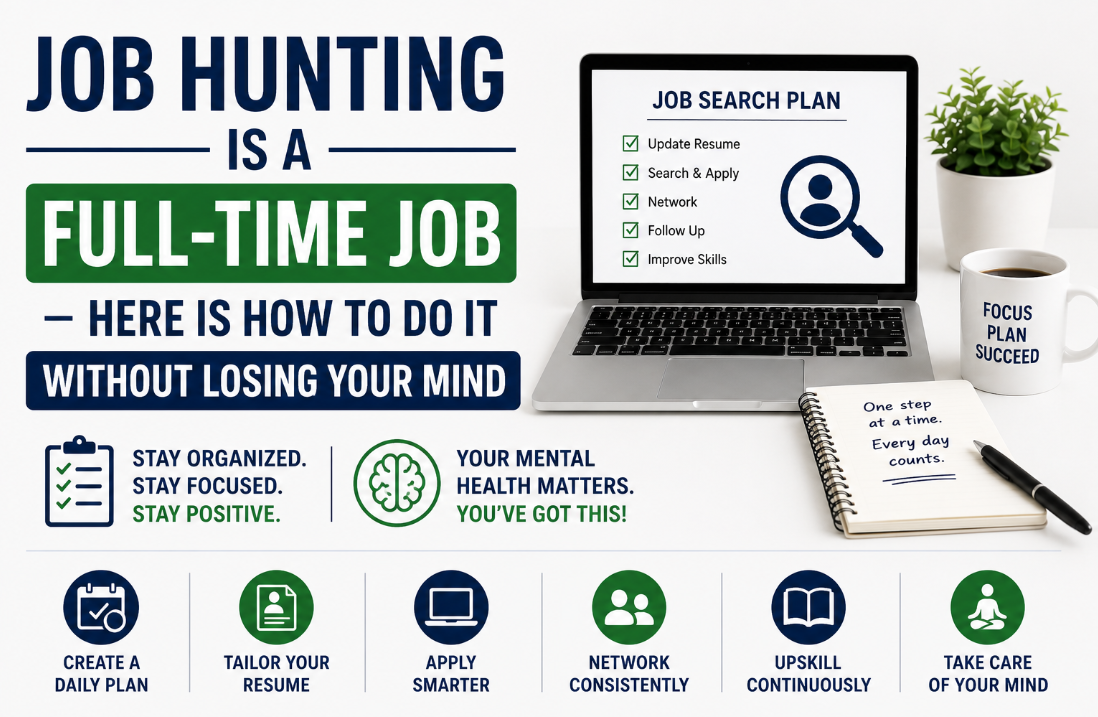
Job Hunting Is a Full-Time Job — Here Is How to Do It Without Losing Your Mind
Nobody tells you how psychologically brutal a job search can be until you are in one.
You spend hours tailoring applications. You send them into what feels like a void. You wait. Sometimes you hear back. More often, you do not. The rejection emails, when they come at all, are impersonal. The silence is worse. And somewhere underneath all of it, there is a quiet pressure that tightens a little more every week.
This is the honest reality of job hunting. And it is also manageable if you approach it the right way.
This post is not about toxic positivity or generic productivity tips. It is a practical framework for running a job search that is structured enough to be effective, bounded enough to be sustainable, and honest enough to protect your mental health along the way.
Treat It Like a Job — But Give It Office Hours
The biggest mistake most job seekers make is letting the job search bleed into every part of their day. They check their email at midnight. They scroll job boards at 11 pm. They spend Sunday anxious about the week ahead. This does not make the search more effective; it makes it more exhausting.
Set defined job search hours. Three to five hours per day of focused, intentional effort is more productive than eight hours of unfocused anxiety-browsing. Outside those hours, close the tabs and do something else.
What goes inside those hours:
- Research — finding specific roles at specific companies that genuinely fit
- Application writing — tailored cover letters and CV adjustments for each role
- Networking — LinkedIn outreach, informational conversations, following up on leads
- Skill building — certifications, portfolio projects, practising interview answers
- Admin — tracking applications, following up, scheduling interviews
What does not go inside those hours: mindless job board scrolling, compulsive email checking between applications, and reading advice articles instead of applying.
Track Everything in a Simple System
A job search without a tracking system becomes overwhelming quickly. Applications blur together. You forgot which company you applied to two weeks ago. You miss a follow-up window. You accidentally apply to the same role twice.
Build a simple tracker; a Google Sheet works perfectly. Track: company name, role title, date applied, application status, next action, and any notes. Update it after every application and every communication.
This does one practical thing and one psychological thing. Practically, it keeps you organised and ensures nothing falls through the cracks. Psychologically, it gives you visible evidence of your effort, which matters enormously during a search that can otherwise feel like you are achieving nothing.
Set Weekly Goals, Not Daily Ones
Daily goals in a job search are unreliable because the work is uneven. Some days, you will submit three strong applications. Others will spend four hours on research that results in one application. If you judge daily progress by output, you will constantly feel like you are failing.
Set weekly goals instead. Aim to apply to a specific number of well-matched roles per week (quality over quantity, five targeted applications beat twenty generic ones), make two to three new professional connections, and complete one skill-building activity.
Review your week on Friday. Not to punish yourself for what you did not do, but to honestly assess what worked and adjust next week accordingly.
Manage Rejection Deliberately
Rejection is structural in job searching; most applications do not lead to interviews, most interviews do not lead to offers. This is true for everyone, not just you. Understanding this intellectually is easy. Experiencing it repeatedly is harder.
A few things that actually help:
Do not attach your self-worth to individual applications. Each application is a low-probability event. Your worth as a professional is not determined by any single company’s hiring decision.
Debrief, do not dwell. When you receive a rejection, spend ten minutes asking whether there is anything useful to learn from it. Then close it. Not every rejection has a lesson; sometimes it is just the lottery of hiring. Take what is useful and move on.
Keep your pipeline full. The psychological weight of a single pending application is enormous — if that one does not work out, the gap feels catastrophic. Keep five to ten active applications in progress at any time, so no single outcome carries all your emotional weight.
Protect Your Physical Routines
Job searching typically involves a lot of sitting, a lot of screen time, and a disruption to the social structure that work normally provides. Left unmanaged, this creates a feedback loop of physical sluggishness and mental fog that makes the search harder.
The basics are obvious, but they are obvious because they work: exercise regularly, even briefly. Get outside at least once a day. Maintain consistent sleep times. Eat properly. These are not aspirational wellness goals; they are the maintenance costs of sustained cognitive performance.
Physical routine also provides structure during a period when structure has largely disappeared. The consistency of a morning walk or an evening workout creates reliable anchors in a day that would otherwise feel shapeless.
Build In Non-Job-Search Time Every Day
This sounds counterintuitive; should you not be maximising your search time? No. Burnout in a job search does not look like fatigue. It looks like losing the ability to write a good cover letter. It looks like dreading opening your laptop. It looks like sending generic applications just to feel like you are doing something.
Protect time every day for things that have nothing to do with job searching. A hobby, a creative project, time with people you care about, physical activity, reading, cooking — anything that engages you and is not a search. This is not a reward for productivity. It is maintenance for the person doing the searching.
Talk About It: Selectively
One of the most isolating aspects of a job search is the social pressure to appear fine. People ask how the search is going, and you say it is going well because the real answer feels vulnerable. The result is that you carry the weight of it alone, which makes it heavier.
Find one or two people, ideally people who have been through a serious job search themselves, with whom you can be honest. Not to vent endlessly, but to have a realistic conversation about how it is actually going, what is challenging, and what you are learning. The combination of being heard and being reminded that this is a normal human experience is genuinely valuable.
Know When to Adjust the Strategy
If you have been applying consistently for eight weeks or more without reaching the interview stage, the problem is likely the strategy, not you. This is the time to assess:
- Are you applying to roles you are genuinely qualified for?
- Are your applications (CV and cover letter) as strong as they should be?
- Are you applying to enough roles, or too few?
- Is your LinkedIn profile optimised?
- Are you applying through referrals and networking as well as job boards?
A job search that is not working after eight weeks of genuine effort needs adjustment, not more of the same. Get outside feedback on your application materials. Ask someone in your industry to review your CV. Change something, because repeating the same approach and hoping for different results is the definition of a strategy problem.
Related Resources on This Site
When you are ready to apply or to strengthen your materials:
- How to Write a CV That Gets You a Remote Job in 2026
- How to Write a Cover Letter for a Remote Job in 2026
- LinkedIn Profile Tips for Getting Hired Internationally
- Entry Level Remote Jobs That Pay in Dollars in 2026
- Browse all current job openings: jobs.iammagnus.com/jobs
FAQ
How many applications should I send per week? Quality beats quantity. Five to ten well-researched, tailored applications per week are more productive than twenty generic ones. The research and tailoring time is not wasted; it directly increases your callback rate.
How long is a normal job search? Entry to mid-level roles typically takes four to twelve weeks from serious application to offer. Senior roles can take three to six months. If you are changing industries or career tracks, allow more time.
Is it okay to take a break from the job search? Yes — a planned one-to-two-day break is different from avoidance. Occasional breaks restore the energy and perspective that sustained searching depletes. Avoidance grows over time; a deliberate break has a defined endpoint.
What if I genuinely feel depressed during the search? A prolonged job search is a genuine stressor and can contribute to or worsen depression. If you are feeling persistently low, unmotivated, or hopeless beyond normal job-search discouragement, speak to a doctor or mental health professional. This is not weakness; it is appropriate self-care in a genuinely difficult situation.

