
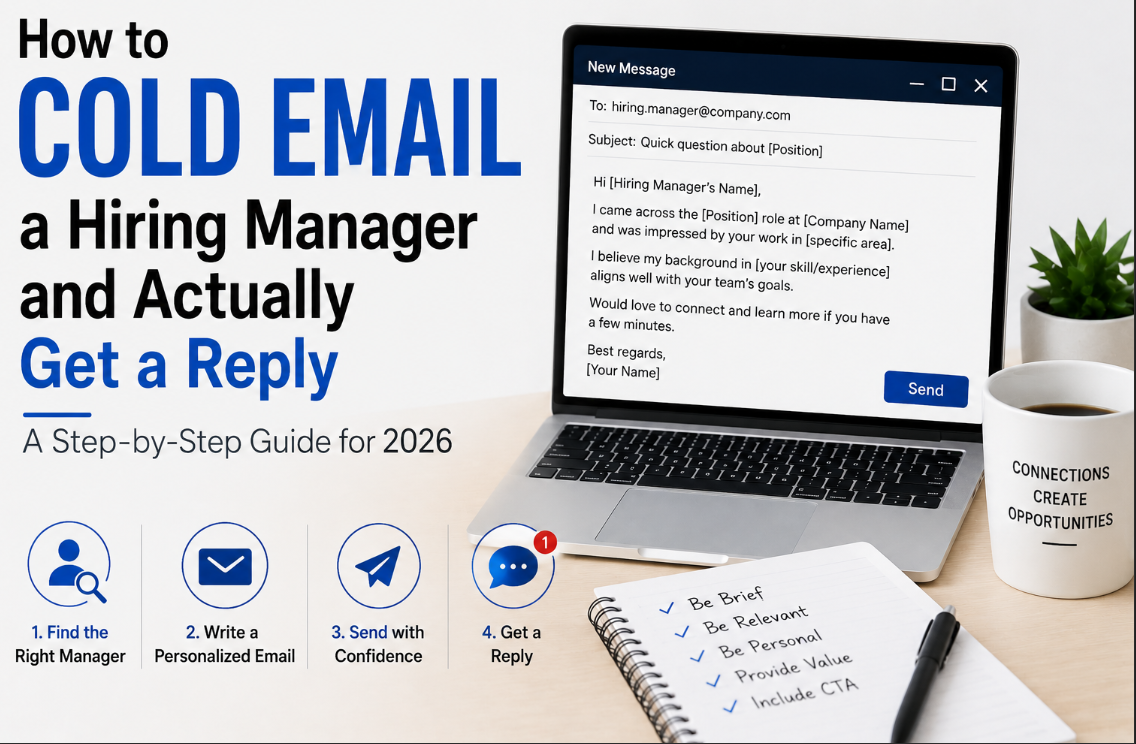
How to Cold Email a Hiring Manager and Actually Get a Reply — A Step-by-Step Guide for 2026
Most job seekers apply through job boards and wait. The ones who get hired fastest often bypass the queue entirely by emailing the hiring manager directly before, during, or instead of the formal application process.
Cold emailing a hiring manager feels bold. Most people do not do it because they assume it will come across as pushy or presumptuous. The truth is that most hiring managers respect the initiative when the email is done correctly. When it is done incorrectly, it gets deleted in two seconds.
This guide gives you the exact framework for a cold email that gets read, gets respected, and gets replies.
Why Cold Emailing Works
When a job is posted on LinkedIn or Indeed, it can receive hundreds or thousands of applications within the first 24 hours. Many of these are screened by ATS software before a human reads them, and the human who does read them is typically a recruiter, not the hiring manager who will actually be working with you.
A well-crafted cold email to the hiring manager bypasses all of this. It lands in their personal inbox, is read by the person who matters most, and creates a human connection before the formal application machinery kicks in.
Not every cold email gets a reply. But even a 20% reply rate from ten targeted emails is two conversations, which is often more than a hundred applications on job boards produce.
Step 1: Find the Right Person to Email
The right person is the hiring manager for the specific role, not the CEO, not the general HR inbox, not a recruiter. The hiring manager is the person you would be reporting to if you got the job.
How to find them:
On LinkedIn: Search for the company name and filter by department. If you are applying for a marketing role, look for the Head of Marketing, Director of Marketing, or VP of Marketing. Check their profile to confirm they are at the right seniority level to be hiring.
From the job listing: Many job listings name the team or manager. “You’ll be reporting to the Head of Customer Success” tells you exactly who to find.
Once you have their name, find their email address using Hunter.io (free tier: 25 searches per month), which searches publicly available data to find professional email formats. Alternatively, if you know the company’s email format (e.g. firstname@company.com or firstname.lastname@company.com), you can deduce it from their name.
Step 2: Write an Email That Is Short, Specific, and Human
This is where most cold emails fail. They are too long, too generic, or too obviously templated. A cold email to a hiring manager should be read in under 60 seconds and leave them with one clear impression: this person knows what they are doing and knows something specific about us.
The structure:
Line 1: The specific opener. Reference something real and specific about the company or their work. Not “I have long admired your company,” that is filler. Something like: “I read your recent case study on how you reduced customer churn by 34% using in-app messaging, it’s exactly the kind of approach I’ve been applying in my current role.”
Lines 2–3: Your relevant credential. One to two sentences maximum on who you are and what you bring. Be specific. “I’m a customer success manager with three years at a B2B SaaS company, where I built the onboarding programme from scratch and improved 90-day retention by 28%.”
Line 4: The clear, low-friction ask. Do not ask for a job. Ask for a conversation. “I’d love to find out if there’s a fit, would you have 15 minutes for a call this week or next?”
Sign-off: Your name, a link to your LinkedIn profile, and nothing else.
Total length: five to seven sentences. If your cold email is longer than this, edit it down.
Step 3: The Subject Line
Your subject line determines whether the email gets opened. It should be specific, professional, and free of anything that sounds like marketing.
Strong subject lines:
- “Customer success background, interested in [specific role]”
- “Re: [Company Name]’s onboarding approach — question.”
- “Referred by [mutual connection name]” — only if genuinely true
- “[Your name] — [role title] with experience in [their specific context]”
Weak subject lines:
- “Opportunity for collaboration”
- “Reaching out”
- “Job enquiry”
- “Your next great hire”
The best subject lines are specific enough that the recipient immediately knows what the email is about, and curious enough that they open it.
Step 4: Follow Up Once
If you do not receive a reply within five to seven business days, send one follow-up. Keep it even shorter than the original, two to three sentences. Reference your original email, restate your interest briefly, and leave the door open.
“Hi [Name], just following up on my email from last week. Still very interested in [Company] and happy to connect if the timing works. No pressure either way.”
Send one follow-up. If there is still no reply after that, move on. Two emails is persistence. Three or more is harassment.
The Full Example
Here is a complete cold email that applies the framework above:
Subject: Customer success background, interested in your CS team
Hi Sarah,
I came across your recent blog post on how you scaled customer onboarding after your Series B, specifically the part about reducing time-to-value from 45 days to 12. That’s a problem I’ve spent the last three years working on.
I’m currently a Customer Success Manager at a B2B SaaS company, where I redesigned our onboarding sequence and moved our 90-day retention rate from 71% to 89%. I’m now looking for my next challenge at a company that’s still actively building and iterating on the CS function rather than just maintaining it.
I’d love to find out if there’s a fit, would you be open to a 15-minute call this week or next?
Best, [Your Name] linkedin.com/in/yourname
That email will get read. It will get replies. Not every time, but consistently more often than any job board application.
Where to Find the Right Writing Jobs and Remote Roles to Cold Email For
Browse current remote roles at 👉 jobs.iammagnus.com/jobs
FAQ
Is cold emailing a hiring manager unprofessional? No. Done correctly, it is one of the most professional things a candidate can do. It demonstrates research, confidence, and initiative, all qualities employers want. The key is keeping it concise, specific, and respectful of their time.
What if there is no open role at the company? Send a speculative cold email anyway, framed around your interest in the company rather than a specific role. Some of the best hires happen before a role is formally posted — because a hiring manager met the right candidate first.
Should I mention salary expectations in a cold email? No. Keep the cold email focused on creating a connection and earning a conversation. Salary is a later-stage discussion.
What if I get no replies at all? Review your email against the framework above. The most common problems are: too long, too generic, asking for too much in the first message, or weak subject lines. Test different openers and subject lines across ten emails before drawing conclusions.

