
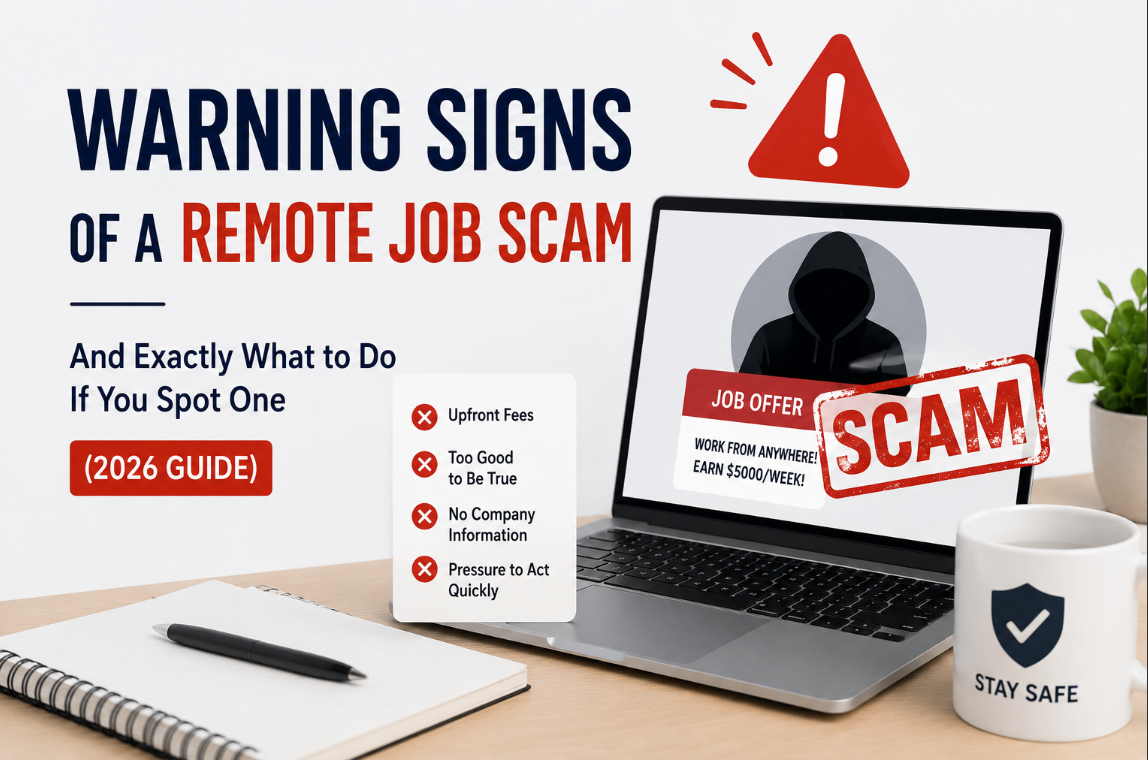
Warning Signs of a Remote Job Scam, And Exactly What to Do If You Spot One (2026 Guide)
Remote work has opened up the global job market in ways that would have been unimaginable fifteen years ago. It has also opened up a global scam market. For every legitimate remote opportunity, there are predatory fake listings designed to steal your money, your personal information, or both.
In 2026, remote job scams are more sophisticated than ever. They no longer look like obvious spam. They have professional websites, realistic job descriptions, and convincing interview processes. Some scammers have gone so far as to impersonate real companies, creating fake versions of legitimate employers to deceive applicants.
This guide tells you exactly what to look for, how to verify a legitimate opportunity, and what to do if something feels wrong.
Why Remote Job Scams Are Worse Than They Used to Be
The shift to remote work has created a perfect environment for scammers for three reasons.
First, the absence of a physical office makes verification harder. You cannot walk past a building and confirm a company exists. Everything happens online, which means a sophisticated scammer can create a convincing facade without any real infrastructure.
Second, the global nature of remote hiring means job seekers are less likely to know whether an unfamiliar company is legitimate. A Nigerian applicant receiving an offer from a company they have never heard of in the US has less ability to verify it through local knowledge.
Third, the desperation that often accompanies a job search, especially a long one, makes people more susceptible to offers that seem too good to pass up.
Understanding these dynamics is the first line of defence.
The Red Flags: What Scams Look Like in 2026
Red Flag 1: The Salary Is Unrealistically High for the Role
If a customer support role is offering $80,000 a year, or a data entry position is promising $5,000 per week, something is wrong. Legitimate remote salaries are competitive, but they are anchored to real market rates. Use glassdoor.com, levels.fyi, or our own salary guides to cross-check whether the number being offered is realistic for the role type and company size.
Scammers use inflated salary numbers specifically because they know job seekers will be less likely to ask critical questions when they are excited about an offer.
Red Flag 2: The Job Offer Arrived Without You Applying
You did not apply for this job. You received an email, a WhatsApp message, or a LinkedIn DM offering you a position out of nowhere, often with a vague description and an urgent timeline.
Legitimate employers do not cold-offer jobs to strangers. Recruiters at real companies do occasionally reach out about specific roles, but they do so via professional channels, reference a specific role with a proper job description, and invite you to apply rather than offering you the job immediately.
Unsolicited job offers are almost always scams. Full stop.
Red Flag 3: They Ask You to Pay for Anything
This is the clearest and most absolute red flag in remote job searching. Legitimate employers never ask candidates to pay for:
- Training materials or onboarding kits
- Background check fees
- Equipment deposits
- Visa processing fees
- Application processing fees
- “Registration” on a job platform
If anyone in a hiring process asks you to send money — via bank transfer, cryptocurrency, gift cards, or any other method — you are being scammed. Stop all communication immediately.
Red Flag 4: The Interview Happens Only on WhatsApp or Telegram
Real companies conduct interviews via Zoom, Google Meet, Microsoft Teams, or phone. They do not interview exclusively via WhatsApp or Telegram text chat.
A “hiring manager” who insists on conducting your entire interview through WhatsApp messages is almost certainly not a hiring manager at a real company. This format allows scammers to avoid video verification (which would reveal they are not who they claim to be) while maintaining the appearance of a professional process.
Red Flag 5: The Company Cannot Be Verified
Search for the company on Google, LinkedIn, Companies House (UK), or the relevant business registry in their claimed country. A real company will have:
- A professional website with a legitimate domain
- A LinkedIn company page with employees
- Verifiable registration information
- Reviews on Glassdoor or Indeed
- A physical address that can be confirmed
If none of these exist, or if the website was created recently and has no real content beyond the jobs page, the company is likely fake.
Specifically for UK-based company claims — search the company name on companieshouse.gov.uk. Every legitimate UK-registered company appears here. If it does not appear, it is not a registered UK company, regardless of what the scammer claims.
Red Flag 6: The Job Description Is Vague or Generic
“Work from home, earn $500 daily, flexible hours, no experience required” is not a job description. It is a scam template. Legitimate remote job descriptions specify the role clearly, describe the company’s product or service, list specific responsibilities and requirements, and name the reporting structure.
Vague job descriptions are deliberately vague — because the “job” either does not exist or is a front for something else (often a pyramid scheme, a reshipping scam, or a money mule operation).
Red Flag 7: They Want Your Personal Documents Immediately
A legitimate employer will not ask for your passport, national ID, bank account details, or NIN before you have signed a contract and been formally onboarded. Asking for sensitive personal documents early in a hiring process, before an offer letter has been issued, is a data harvesting scam.
Your documents can be used to commit identity fraud. Never share them until you have independently verified the company is legitimate, and you have a formal offer in hand.
Red Flag 8: The Email Domain Does Not Match the Company
If someone claims to be from Google but their email is @gmail.com instead of @google.com, that is not Google. If someone claims to represent a company called TechCorp but their email is techcorp-hiring@yahoo.com instead of a professional @techcorp.com domain, that is a scam.
Legitimate companies use their own email domains for hiring. Always check the sender’s domain before trusting any communication.
The Specific Scam Types to Know in 2026
The Reshipping Scam: You are hired as a “logistics coordinator” or “package handler” to receive goods at your address and reship them. The goods are stolen. You become an unwitting participant in a theft operation. You can face legal consequences.
The Money Mule Scam: You are hired as a “payment processor” or “financial assistant” to receive money into your bank account and transfer it to another account. The money is from fraud or money laundering. You commit a serious crime, and your bank account is closed permanently.
The Training Fee Scam: You are offered a job, told you need to complete a paid training programme to start, pay the fee, and the “company” disappears.
The Fake Recruitment Agency Scam: A fake agency contacts you, charges a “placement fee” or “registration fee” to help you find a remote job, takes your money, and provides nothing. Legitimate recruitment agencies are paid by employers, never by candidates.
The Impersonation Scam: A scammer creates a fake website and email domain that closely mimics a real company — changing one letter in the domain (e.g. @microsooft.com instead of @microsoft.com). They offer you a job, conduct a fake interview, and then request documents or fees.
How to Verify a Remote Job Opportunity: A Checklist
Before investing significant time in any remote job application, run through this verification:
- Can I find the company independently on Google, not just through the link they sent me?
- Does the company have a LinkedIn page with real employees?
- Is the job listed on the company’s official careers page — not just on a job board?
- Does the email domain match the company’s official website?
- Is the salary realistic for this role type based on market research?
- Has anyone asked me to pay anything at any stage?
- Was this opportunity offered to me unsolicited or did I apply through a legitimate channel?
- Can I verify the company is registered in its claimed country?
If you cannot check all of these boxes, proceed with extreme caution or do not proceed at all.
What to Do If You Have Been Scammed
If you paid money: Contact your bank immediately. Report the transaction as fraudulent. If you sent via bank transfer, request a recall immediately; the faster you act, the higher the chance of recovery. If you sent via gift cards or cryptocurrency, recovery is extremely unlikely, but you should still report it.
If you shared personal documents: Report to your country’s identity theft or fraud authority. In Nigeria, report to the EFCC (efcc.gov.ng). Monitor your bank accounts and credit cards for unusual activity. Consider placing a fraud alert on your identity.
If you gave banking details, contact your bank immediately to change your account details and flag potential fraud.
Report the scam: Report fake job listings to the platform where you found them (LinkedIn, Indeed, WhatsApp). Report to the real company being impersonated so they can warn others. Report to the relevant authorities in your country.
Tell other people. Remote job scams thrive on silence. The more people who know about specific scam operations, the fewer victims they claim.
Legitimate Places to Find Remote Jobs
Every listing on this site is manually reviewed. Browse current verified remote opportunities at 👉 jobs.iammagnus.com/jobs
Additional verified remote job platforms: We Work Remotely (weworkremotely.com), Himalayas (himalayas.app), Remote.co, Wellfound (wellfound.com), and direct company career pages.
FAQ
Is it a scam if the company asks for my CV before an interview? No, requesting your CV is standard. The red flags are requests for payment, sensitive documents like passports, before formal hiring, or bank details at any stage before onboarding.
Can LinkedIn job listings be scams? Yes. Scammers create fake LinkedIn company pages and post fraudulent listings. Always verify the company independently rather than trusting the LinkedIn listing alone.
What if I am not sure whether an opportunity is legitimate? Trust your instincts and do more verification. Ask the recruiter for the company’s registered address, look up the company independently, and check whether the role exists on the official company careers page. A legitimate employer will welcome these questions; a scammer will become evasive or aggressive.

