
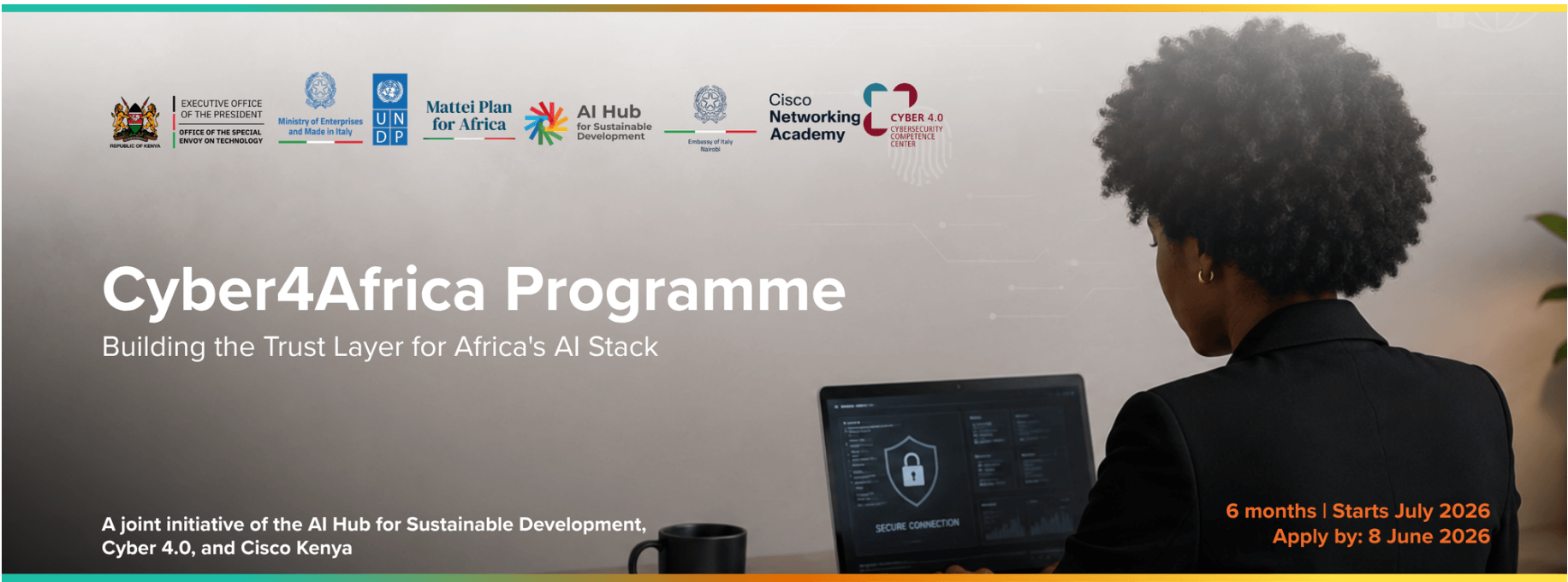
Cyber4Africa Programme 2026 — Free Cybersecurity Training and Support for African AI Startups (Deadline: 8 June 2026)
Across Nairobi, Lagos, Kigali, and Accra, African founders are building AI products that sit at the centre of how millions of people access healthcare, move money, interact with government, and manage energy. These are not small experiments — they are helping define Africa’s role in one of the most consequential technological transitions in human history.
And most of them are building without adequate cybersecurity infrastructure.
Not because the founders are careless. Because the global cybersecurity tools, expertise, and institutional support that exist do not fit African startups’ contexts, budgets, or operational realities. That gap — between the sensitivity of what African AI startups are building and the security infrastructure available to protect it — is what the Cyber4Africa Programme was built to close.
Launched by the AI Hub for Sustainable Development in partnership with Cyber 4.0 and Cisco Kenya, and connected to UNDP’s AI Trust and Safety Re-imagination Programme, Cyber4Africa is a six-month, free cybersecurity capacity-building programme for African AI startups in five priority sectors. It provides structured assessments, expert training, hands-on technical support, and access to Cisco’s Nairobi Cybersecurity Training Centre — at no cost to participating startups.
The application deadline is 8 June 2026. The programme starts 1 July 2026.
Why This Programme Exists — The Problem It Solves
Before getting into the details, it is worth understanding the specific problem Cyber4Africa is addressing — because it shapes everything about who should apply and what the programme delivers.
Consider what happens when cybersecurity fails in the African AI context. A health-tech startup in Nairobi deploys an AI diagnostic tool across rural clinics. Patient records are processed. Treatment recommendations are returned. Uptake grows. Then a data breach exposes sensitive patient information for thousands of people. The breach is not catastrophic by global standards — but in a context where institutional trust is hard-won and easily lost, it does not need to be catastrophic to be terminal. The startup loses its clinic partnerships. The clinics lose their patients’ confidence. The next AI health application entering that market must contend with the distrust left in the wake of the breach.
This pattern repeats across sectors. In fintech, cyberattacks are among the leading drivers of customer loss and operational disruption. In digital government systems, vulnerabilities do not just compromise data — they compromise the legitimacy of the institutions that deployed them. In AI infrastructure, security failures cascade across entire networks of dependent users and systems.
The insight at the heart of Cyber4Africa is that trust and safety are not qualities of a model — they are properties of a system. Of the institutional environment in which a model operates. Of the accountability structures around it. Of the human capacity to monitor, interpret, and intervene when something goes wrong.
Cybersecurity is the foundation of all of this. Startups that build this capability early will not just be more secure. They will be easier to adopt, more attractive to investors, and better positioned to influence the governance discussions that will shape their operating environment.
Who Is Behind This Programme
The AI Hub for Sustainable Development — established on the premise that African innovators should not merely participate in the AI revolution but be central to building it. The Hub’s programmes address specific constraints — compute access, talent development, infrastructure, and standards — that hold African AI startups back.
Cyber 4.0 — an Italian-origin cybersecurity competence centre with deep expertise in cybersecurity capacity building for organisations operating in complex technological environments.
Cisco Kenya — the regional arm of the world’s largest networking and cybersecurity technology company, providing technical infrastructure, regional reach, and access to Cisco’s Cybersecurity Training Centre in Nairobi.
UNDP’s AI Trust and Safety Re-imagination Programme — the United Nations Development Programme’s initiative to reframe how AI trust and safety are built in developing country contexts.
The combination of these four partners means the programme has both the technical depth and the institutional credibility to deliver something genuinely useful — not a generic training course repackaged for an African audience, but a programme designed from first principles around the specific cybersecurity challenges African AI startups face.
What the Programme Covers — Three Workstreams Over Six Months
The programme is structured around three interconnected workstreams, each addressing a different dimension of cybersecurity capability for participating startups.
Workstream 1 — Cyber Resilience and Awareness
Every participating startup receives a Cybersecurity Light Assessment at the programme’s start — a structured evaluation of their current cybersecurity posture. This assessment identifies specific vulnerabilities, gaps, and priority areas before any training or support begins.
From this baseline, startups receive tailored advisory support to:
- Strengthen organisational cybersecurity awareness across their teams
- Align their security practices with international standards
- Understand their specific risk profile given their sector, technology stack, and data environment
This is not generic advice. It is startup-specific analysis delivered by people who understand both cybersecurity and the African AI context.
Workstream 2 — Training and Capacity Building
The training component combines remote and in-person delivery:
Webinars on AI security essentials — covering the specific intersection of AI systems and cybersecurity: data security, model security, inference attacks, supply chain risks, and the security implications of deploying AI in resource-constrained environments.
Cybersecurity starter mini-course — a structured foundational curriculum for startup teams who need to build baseline security competence across technical and non-technical functions.
Access to Cisco’s Cybersecurity Training Centre in Nairobi — hands-on, in-person workshops at one of East Africa’s most capable cybersecurity training facilities. For founders and technical teams who have never had access to professional-grade cybersecurity training infrastructure, this is a genuinely significant opportunity.
Workstream 3 — Technical and Operational Support
The most hands-on component of the programme. Participating startups receive:
Expert engagement and technical office hours — direct access to cybersecurity specialists from Cyber 4.0’s network for specific technical questions, implementation guidance, and problem-solving.
AI Security Quick Scan — a focused technical assessment of AI-specific security vulnerabilities in the startup’s product or platform.
Implementation support — hands-on help to implement cybersecurity controls, strengthen incident response capabilities, and improve operational resilience.
This workstream is where abstract security knowledge becomes real security capability — the difference between knowing what good cybersecurity looks like and actually having it.
Five Priority Sectors
The programme is targeted at AI startups in five sectors where cybersecurity exposure is most acute and the consequences of failure are most severe:
Healthcare and Digital Health Patient records, AI diagnostics, and health infrastructure represent some of the most sensitive data in any society. Security failures in health AI do not just expose data — they can compromise care and permanently erode the public trust that health systems depend on. For a continent where formal health infrastructure is still being built, protecting AI health applications from breaches is an existential question for the sector.
Fintech and Financial Services The most cyber-targeted sector globally. Africa’s fintech ecosystem is one of the most dynamic in the world — and one of the most actively targeted by cybercriminals. Cyber incidents in fintech undermine both financial inclusion outcomes and consumer confidence in systems that millions of previously unbanked people are trusting for the first time.
Govtech and Civic Technology Digital identity, e-government platforms, and civic technology sit at the intersection of data sensitivity and institutional legitimacy. A vulnerability in a national ID system or a digital voting platform does not just compromise data — it compromises the credibility of the institution that deployed it and potentially the democratic processes it supports.
Energy and Climate Technology AI-enabled energy infrastructure — smart grids, distributed energy systems, climate monitoring platforms — carries a distinctive risk profile. Digital vulnerabilities in these systems have physical consequences. An attack on energy infrastructure is not just a data problem.
AI Infrastructure and Data Platforms The foundational layer of the entire ecosystem. Startups building the infrastructure on which other AI applications depend — data platforms, model hosting, API layers — sit in the highest-risk position of all. A security failure at the infrastructure layer cascades across every dependent application, user, and institution.
Who Should Apply
The programme is open to African AI startups that meet all of the following criteria:
Stage: An AI-enabled product, platform, or service at MVP stage or beyond. Pre-product or idea-stage startups are not the target — the programme is most valuable to teams already operating and already accumulating cybersecurity exposure.
Data environment: You handle sensitive personal, financial, or operational data. If your product processes patient records, financial transactions, government data, or sensitive personal information, you are in the target group.
Sector: You are building in one or more of the five priority sectors — healthcare, fintech, govtech, energy/climate tech, or AI infrastructure.
Geography: You are Africa-based or building solutions specifically for African markets.
Capacity to participate: You have the operational capacity to actively engage throughout the six-month programme. This is not a passive information course — it requires genuine participation from founders and technical teams.
What You Get Out of It — The Business Case
The programme is free. But beyond the zero cost, why does this matter for your startup’s trajectory?
Investor readiness. Institutional investors, development finance institutions, and impact investors increasingly require evidence of security practices before investing. A structured cybersecurity assessment and documented security controls directly address due diligence requirements that many African startups currently cannot meet.
Partnership and procurement access. Hospitals, banks, government agencies, and large enterprises will not partner with or procure from AI startups that cannot demonstrate security practices. The programme builds the evidence and capability that unlock these institutional relationships.
User trust and retention. In markets where trust is scarce and easily lost, demonstrating that your system is secure is a differentiation strategy, not just a compliance obligation. Startups that can point to independent security assessments and robust security practices will earn and retain user trust more effectively than those that cannot.
Regulatory positioning. As African governments develop AI and data protection regulations — building on frameworks like Nigeria’s NDPR, Kenya’s Data Protection Act, and the African Union’s emerging AI governance standards — startups with documented security practices will be better positioned to shape and comply with regulatory requirements.
The community. Joining a cohort of African AI founders who share a commitment to building securely creates a peer network that outlasts the programme itself. The collective security posture of the African AI ecosystem matters — and the relationships built in Cyber4Africa are part of building it.
Key Dates
| Milestone | Date |
|---|---|
| Application deadline | 8 June 2026 |
| Programme start | 1 July 2026 |
| Programme duration | 6 months |
The deadline is days away. If your startup meets the eligibility criteria, apply now — not after the weekend.
How to Apply
Submit your application through the AI Hub for Sustainable Development’s official application portal. The application link is published on the programme page.
For questions about eligibility or the application process, contact the programme team directly at aihubforsustainabledevelopment@undp.org.
Honest Assessment — Is This Worth Your Time?
For African AI startups in the five priority sectors — yes, unambiguously.
The combination of a structured security assessment, expert training from Cyber 4.0 and Cisco, hands-on technical support, and access to the Nairobi training facility is worth significantly more than zero — which is what you pay to participate. For startups that are handling sensitive data and operating in high-trust environments, cybersecurity capability is not an optional future investment. It is a present business necessity.
The programme is not for startups that are pre-product or for teams that cannot commit to active six-month participation. It is for founders who are already building, already handling real data, and already facing real cybersecurity exposure — and who want the tools, knowledge, and institutional support to handle it properly before a breach forces them to.
The UNDP and Cisco partnership gives the programme institutional credibility that a stand-alone training programme cannot replicate. The assessment and documentation you receive are materials you can show to investors, partners, and regulators — they have value beyond the programme itself.
Apply before 8 June 2026.
FAQ
Is this programme free? Yes. There is no cost to participating startups. The programme is funded by the AI Hub for Sustainable Development and its partners.
Is this only for Nigerian startups? No. The programme is open to AI startups across the African continent — Nigeria, Kenya, Ghana, South Africa, Rwanda, Ethiopia, and anywhere else in Africa where AI startups are building.
Do I need to be in Nairobi to participate? Training includes both remote and in-person components. The in-person workshops are held at Cisco’s Cybersecurity Training Centre in Nairobi. Remote participation is available for teams not based in Nairobi. Check with the programme team about the specific logistics for your location.
What stage does my startup need to be at? MVP stage or beyond. Pre-product startups are not the primary target — the programme is most valuable to teams already operating and accumulating cybersecurity exposure.
Can we apply if we are not in one of the five sectors? The programme prioritises the five specified sectors. If your startup operates in a different sector but handles sensitive data and has significant cybersecurity exposure, contact the programme team at aihubforsustainabledevelopment@undp.org to discuss your eligibility.
What is the time commitment? The programme runs for six months from July 2026. Active participation is required — including the initial assessment, training sessions, office hours, and implementation support activities. Assess your team’s capacity honestly before applying.
What happens after the six months? You become part of a community of African AI founders committed to building securely. The programme explicitly aims to build a lasting community of practice — not just a one-time cohort.
Where do I send questions? Email aihubforsustainabledevelopment@undp.org with any questions about the programme or application process.
For more information and application:
Visit the official website of the Cyber4Africa Programme 2026

