
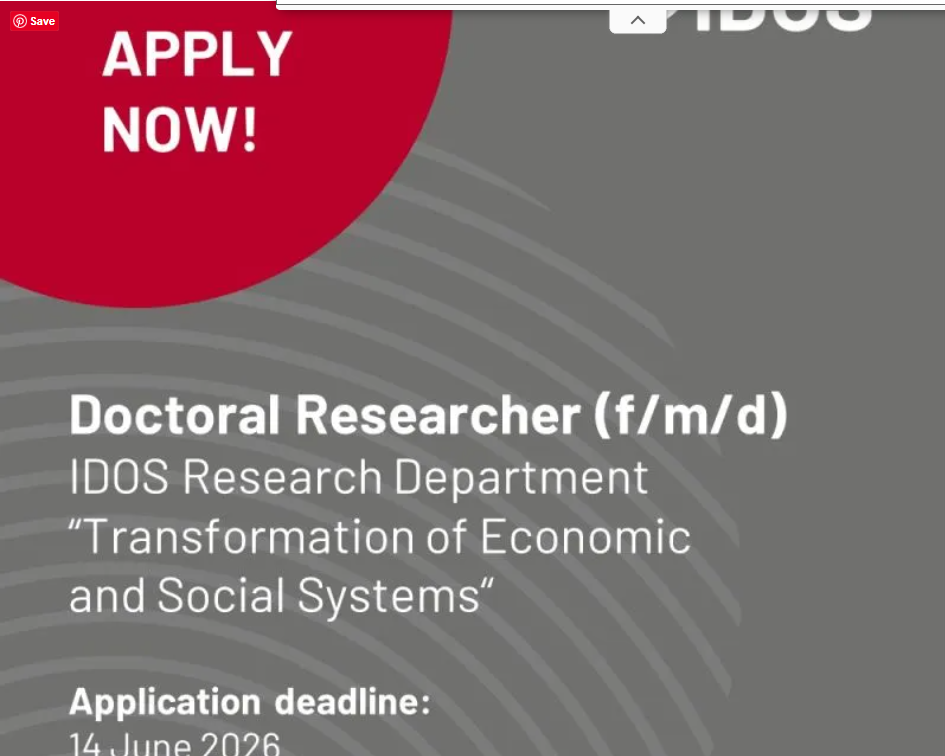
IDOS Doctoral Researcher Position 2026: Paid PhD in Germany on Food Systems, Open to Africans
Most PhD opportunities require you to self-fund, secure a scholarship separately, or survive on a stipend that barely covers rent. This one is different.
The German Institute of Development and Sustainability (IDOS) is currently advertising a paid Doctoral Researcher position. This salaried role comes with the full German public sector benefits package while you complete your PhD. The deadline is 14 June 2026, which means if you are reading this today, you have days left.
Here is everything you need to know.
What This Actually Is
This is not a scholarship. It is an employment contract.
You would be hired by IDOS as a part-time employee (65% position, 25.4 hours per week) under Germany’s TVoeD Bund public sector pay scale at EG 13. The gross annual salary ranges from €40,000 to €58,000 at 65%, which, in real terms, means you are earning roughly €2,600–€3,100 per month while writing a PhD.
At least 50% of your contracted work time is reserved exclusively for your dissertation. The rest goes toward project tasks, fieldwork, collaboration, and reporting.
The position starts 1 October 2026 and runs for three years, with a possible extension of up to nine additional months.
What the Research Is About
The position sits inside a larger German Research Foundation (DFG) funded project called FoodDiverse, formally titled “Food System Diversification for Sustainable Nutrition.” It is a collaborative research centre linking IDOS, the University of Bonn, and the University of Ghana.
Your specific sub-project is: Behavioural Strategies to Diversify Food Consumption.
In plain language: you will research why people eat what they eat, how to increase plant-based protein consumption across different social groups, and what policy changes could drive that transformation, with fieldwork conducted in both Ghana and Germany.
This is genuinely interesting research if your background is in social sciences, agricultural economics, anthropology, human geography, or nutrition. It’s also Africa-relevant in a direct way; Ghana is a core fieldwork location, which means you would be doing real research on the continent, not just citing it from a desk in Europe.
Who Can Apply
Minimum qualification: a Master’s degree in a relevant social science (Human Geography, Sociology, Political Science, Anthropology) or in Agricultural and Nutrition Sciences.
They want someone who:
- Has experience with qualitative and ethnographic social research methods
- Is genuinely motivated to do a PhD — not just get a degree, but pursue a research question
- Has research or work experience in Africa (an asset, not a requirement)
- Speaks fluent English (German is a bonus, not mandatory)
- Is willing to travel, including to countries with tropical climates
One specific administrative requirement: if you hold a non-German university degree, you need to attach a database excerpt from Anabin (the German Central Office for Foreign Education’s database) as proof of degree recognition. Nigerian university degrees are recognisable; check via anabin.kmk.org to find your specific institution.
The IDOS Dual PhD Programme
IDOS runs what they call a dual PhD programme, meaning the PhD is designed to combine academic research with policy advice work. You’re not just writing theory; you’re trained to translate research into recommendations that policymakers can actually use.
The support structure includes:
- Group mentoring and training workshops
- Peer mentoring with other PhD students at IDOS
- One-on-one supervision by Prof. Dr. Anna-Katharina Hornidge (your primary supervisor, based at IDOS and the University of Bonn)
The degree itself will be awarded by the University of Bonn’s Faculty of Social Sciences, a well-ranked German research university with an internationally recognised development studies and agricultural sciences track.
What the Benefits Package Looks Like
This is worth paying attention to because it’s not common:
- Flexible working hours
- Up to 60% remote working per week (within Germany)
- Subsidised Germany-wide public transport ticket (Deutschlandticket)
- Special annual payment (13th-month equivalent under TVoeD Bund)
- Up to 30 days annual leave plus 6 additional company leave days
- Employer pension contribution through VBLU
- Professional development training
- Audit-certified work-family compatibility
For an international PhD student, this package is substantially better than what most scholarship-funded PhD programmes offer.
How to Apply
Applications must be submitted exclusively through the IDOS online application portal. The position number is 2026-B-02; include this in your application.
You need to submit:
- Cover letter (this is the most important document; explain your research motivation, connection to food systems or development work, and why IDOS specifically)
- Curriculum vitae
- Relevant degree certificates and transcripts
- Anabin database excerpt confirming recognition of your degree (required for non-German degrees)
Deadline: 14 June 2026 at 23:59 CET
Interviews are expected to take place in July 2026.
For questions, contact Prof. Dr. Anna-Katharina Hornidge directly at: directorate.office@idos-research.de
Apply at: idos-research.de
A Note on the Anabin Requirement
This is the step that trips up most international applicants and causes last-minute panic. Do it today.
Go to anabin.kmk.org → click “Institutionen” → search for your university by name → find your degree level → check the H+, H+/-, H- rating.
Most Nigerian federal universities hold an H+ rating for their bachelor’s degrees, meaning they are fully recognised. Take a screenshot or download the page as your Anabin excerpt. Attach it to your application as a PDF.
If your university is not listed or has an unclear rating, email ZAB (the Central Office for Foreign Education) for a formal evaluation — but this takes time, so act immediately.
Why This Is Worth Your Attention
Most funded PhD positions in Europe require you to already be in the country, already have a supervisor relationship, or already hold an EU degree. This one is explicitly open to international applicants, is Africa-facing in its research design, and pays a salary rather than a stipend.
It’s rare. The deadline is approaching. If your background fits, stop reading and start the cover letter.
Related opportunities on the site:
- Friedrich Ebert Foundation Scholarship 2026 — €992/Month for International Students in Germany
- AFRIKA KOMMT! Fellowship 2026–2028 – Fully Funded Leadership Programme in Germany
- Africa Fellows in Education Program (AFEP) 2026/2027 — $25,000 Research Grant for Young African Researchers
- Global South Fellowship Program 2026 — Fully Funded Visiting Fellowship at the University of Birmingham and University of Illinois
- Top 20 Fully Funded Scholarships to Study in the USA, UK, Canada, and Other Top Countries in 2026
For more information and application:

