
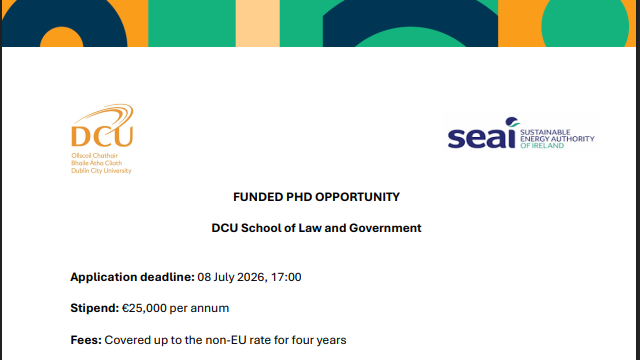
Dublin City University is offering a fully funded 4-year PhD scholarship — €25,000/year stipend plus full fees — to research energy poverty and just transitions in social housing. Open to international students. Deadline: 8 July 2026 at 17:00.
Overview
Here is a funded PhD opportunity that sits at one of the most urgent intersections of our time: climate change, social housing, and the people being left behind in the energy transition.
Dublin City University (DCU) is offering a fully funded four-year doctoral scholarship in its School of Law and Government, starting September 2026. The scholarship pays a €25,000 annual stipend and covers full tuition fees up to the non-EU rate — meaning international students are fully supported, not just EU residents.
The position is part of SHINE, a government-funded interdisciplinary research project exploring how social housing residents in Ireland engage with clean energy transitions. The research sits at the intersection of public policy, citizen engagement, housing governance, and emerging technology — and the approach is deliberately open. You are encouraged to develop your own research question within this framework.
Deadline: 8 July 2026 at 17:00 Irish time. That is days away. If this fits your profile, your application needs to begin today.
About the SHINE Project
SHINE — funded by the Sustainable Energy Authority of Ireland (SEAI) — stands as one of Ireland’s most socially grounded energy research initiatives. It is led by Dr Valesca Lima from DCU’s School of Law and Government and Professor Stephen Daniels from DCU’s School of Electronic Engineering.
The project’s core question is deceptively simple but enormously complex: how do residents of social housing — some of Ireland’s most vulnerable households — actually engage with the national push toward clean energy and decarbonisation?
Ireland, like every other country, has ambitious climate targets. But those targets land differently depending on where you live and what resources you have access to. Social housing residents often face the highest energy costs, the worst-insulated homes, and the least agency in decisions about energy infrastructure. SHINE uses citizen science — research conducted with and by community members — to generate knowledge that can genuinely inform housing and climate policy, rather than policy made about communities without their input.
The PhD researcher joining SHINE will develop their own doctoral project within this broader framework, contributing to one of the most practically important debates in Irish and European policy: what does a truly just transition look like for the people who have the most to lose?
PhD Research Focus — What Will You Study?
This position is deliberately open in its research framing, which is both unusual and valuable. The supervisory team is inviting applicants to bring their own perspective, their own disciplinary angle, and their own research questions to the project.
The indicative research theme is socio-technical policy and governance research, sitting at the intersection of:
- Public policy and housing governance — how housing regulations, climate action plans, and energy policy are designed, implemented, and experienced
- Citizen engagement and participation — how community members are involved in decisions about energy infrastructure and what that involvement actually changes
- Human-data and human-technology interaction — how real-time monitoring, smart meters, energy feedback tools, and citizen science data shape household behaviour and energy literacy
- Just transition governance — what fairness and equity require in the shift away from fossil fuels, particularly for low-income and vulnerable communities
Possible specific directions within this framework include:
- How citizen science data collected from social housing residents can meaningfully inform national housing strategies
- How real-time energy feedback loops shape household energy literacy and behavioural change among social housing residents
- How existing public policy frameworks and housing regulations facilitate or obstruct a just transition for vulnerable households
- How emerging technologies for energy management can be designed and deployed in ways that address energy poverty rather than deepening it
You are not expected to arrive with a fully formed research design. You are expected to arrive with a genuine intellectual interest in these themes and the analytical tools to develop a rigorous question within them.
Who Can Apply? (Eligibility)
Required:
- A Level 8 Bachelor’s Degree (Honours degree) in one of the following areas:
- Political Science
- Public Policy
- Sociology
- Human Geography
- Education
- OR an engineering/environmental field such as Data Science, Environmental Science, or Sustainable Systems — with a strong demonstrated interest in social justice
Desirable (not required):
- A Level 9 Master’s degree in a relevant field
The range of eligible backgrounds here is genuinely broad. This is not a position for computer science graduates alone, nor is it exclusively for policy researchers. The project is explicitly interdisciplinary — it needs someone who can operate across the technical and the social, the quantitative and the qualitative, the engineering and the governance.
A Data Science or Environmental Science graduate with clear engagement in social justice, housing, or community issues is as competitive here as a Public Policy or Sociology graduate who has engaged with technology and data. What the application needs to demonstrate is how your particular background connects to the project’s themes.
The position is open to Irish, EU, and international candidates. Non-EU applicants have their fees covered at the full international rate — this is explicitly stated in the award terms.
What You Get (Funding Package)
| Benefit | Details |
|---|---|
| Annual stipend | €25,000 per year |
| Duration | 4 years |
| Tuition fees | Fully covered up to the non-EU rate |
| Funder | Sustainable Energy Authority of Ireland (SEAI) |
| Location | Dublin City University, Dublin, Ireland |
| Start date | September 2026 |
€25,000 per year in Dublin is a livable stipend — particularly given that DCU is located in Glasnevin, one of Dublin’s more affordable residential areas. Dublin is expensive compared to Cork or Galway, but the fully covered fees mean that the stipend is entirely available for living costs rather than being eaten by tuition. For international students who would otherwise be paying upward of €12,000–€18,000 in annual fees, having those covered at the non-EU rate is a substantial benefit.
About Dublin City University
DCU is a modern, research-active public university located on Dublin’s northside. It has grown significantly since its establishment in 1989 and now ranks among Ireland’s leading research institutions, particularly in engineering, communications, education, and governance.
DCU’s School of Law and Government is known for interdisciplinary, policy-relevant research. Its staff work across political science, public law, governance, and social policy — with strong connections to Irish government departments, EU institutions, and civil society organisations. The SHINE project, funded by SEAI, exemplifies the school’s orientation: research designed to have real policy impact, not just academic output.
Dublin itself requires little introduction as a destination. It is an English-speaking, EU capital city with a dynamic economy, a large and growing technology sector, strong public infrastructure, and an increasingly diverse population. Ireland’s graduate visa and post-study work options make it a practical choice for international students with career ambitions in Europe.
How to Apply
The application for this position is simple and direct — no elaborate portal, no long list of documents.
Submit the following by email to:
tracymae.ildefonso@dcu.ie
Documents required:
- Curriculum Vitae — maximum 3 pages
- Motivation letter — maximum 2 pages
That’s it. Two documents. But don’t let the simplicity mislead you — both documents need to be strong, specific, and targeted to this position.
Deadline: 8 July 2026 at 17:00 Irish time (UTC+1)
Shortlisted candidates will be invited to online interviews in mid-July. Successful applicants may be required to provide proof of English language proficiency.
How to Write a Strong Application for This Position
Your CV (Maximum 3 Pages)
Prioritise relevance over comprehensiveness. The selection committee needs to see:
- Your degree(s) — subject, institution, classification
- Any research experience — thesis work, dissertations, research assistant roles, independent projects
- Any engagement with the themes: housing, energy, policy, community work, environmental issues, data or technology in social contexts
- Publications, conference presentations, or other academic outputs if you have them
- Language skills and any international experience
Three pages means three focused, informative pages — not three pages padded to fill the limit.
Your Motivation Letter (Maximum 2 Pages — The Most Critical Document)
This letter is where your application either stands out or disappears into the pile. Two pages is enough space to make a compelling case if you use it well.
What to cover:
Paragraph 1 — Why this project: Be specific. Don’t write generically about caring about climate change or social justice. Explain what it is about the intersection of energy poverty, social housing, and citizen engagement that genuinely compels you intellectually and personally. Reference the SHINE project directly.
Paragraph 2 — What you bring: Connect your academic background to the project’s needs. If you’re a public policy graduate, explain how your policy analysis training equips you to work with housing regulations and climate frameworks. If you’re a data science or environmental engineering graduate, explain how your technical skills can contribute to the citizen science methodology alongside your interest in social justice outcomes.
Paragraph 3 — Your research direction: Sketch a possible research question or direction you might pursue within the SHINE framework. You don’t need a fully formed proposal — but showing that you’ve thought about where your doctoral project might go within this framework demonstrates seriousness and research maturity.
Paragraph 4 — Why DCU and why Dublin: Brief but genuine. What does the DCU research environment offer you specifically? Why is this the right institutional home for this work?
Informal Enquiries
Before submitting your application, you may contact the lead supervisor directly with any questions about the position or the project:
Dr Valesca Lima
valesca.lima@dcu.ie
An informal email before applying — introducing yourself briefly and asking one or two focused questions about the project — can help you tailor your application and give you a sense of fit before committing time to the full submission.
Why This Research Matters
Energy poverty is not an abstract policy concept. In Ireland and across Europe, millions of households spend disproportionate portions of their income on energy, or go without adequate heating because they can’t afford it. Social housing residents are among the most exposed: they often have the least control over their homes’ energy systems, the fewest resources to invest in efficiency improvements, and the least political voice in the decisions that shape their energy future.
The transition to clean energy is one of the defining policy challenges of the next thirty years. If it is done badly — if the costs fall on those least able to bear them and the benefits flow to those who need them least — it will be neither just nor durable. Research that puts social housing residents at the centre of that transition, using citizen science to generate knowledge that actually comes from the communities affected, is exactly the kind of work that can shift how policy is made.
For Nigerian and African researchers with backgrounds in public policy, urban governance, social science, or environmental studies: the themes of SHINE are not Ireland-specific. Energy poverty, housing inequity, and the challenge of just transitions are global problems. Research conducted in Ireland can generate frameworks, methodologies, and findings that travel — and a PhD built around these questions gives you expertise that is relevant on every continent.
Quick Summary Table
| Detail | Info |
|---|---|
| University | Dublin City University (DCU), Dublin, Ireland |
| School | School of Law and Government |
| Project | SHINE (SEAI-funded) |
| Supervisors | Dr Valesca Lima & Prof Stephen Daniels |
| Annual Stipend | €25,000 |
| Fees | Fully covered — up to non-EU rate |
| Duration | 4 years |
| Start Date | September 2026 |
| Open To | Irish, EU, and international candidates |
| Degree Required | Level 8 Bachelor’s in relevant field (Master’s desirable) |
| Application | CV (3 pages max) + Motivation letter (2 pages max) |
| Submit To | tracymae.ildefonso@dcu.ie |
| Deadline | 8 July 2026 at 17:00 Irish time |
| Interviews | Mid-July (online) |
| Informal Enquiries | valesca.lima@dcu.ie |
Apply Now
Email your CV and motivation letter to tracymae.ildefonso@dcu.ie before 8 July 2026 at 17:00.
The deadline is extremely close. If you have the right background and this research genuinely speaks to you, don’t spend another day deliberating. Start your motivation letter today.
And if this isn’t your position — if the research area doesn’t fit your training or interests — share this post with someone who works in public policy, social science, environmental studies, urban planning, or data science and has been looking for a funded PhD route in Europe. A €25,000 stipend with full fee coverage in Dublin, working on one of the most practically important policy questions in European climate governance, is the kind of opportunity that deserves to reach the right person before Tuesday.
For more information and application:
Visit the official website of the Fully Funded PhD at Dublin City University 2026

