
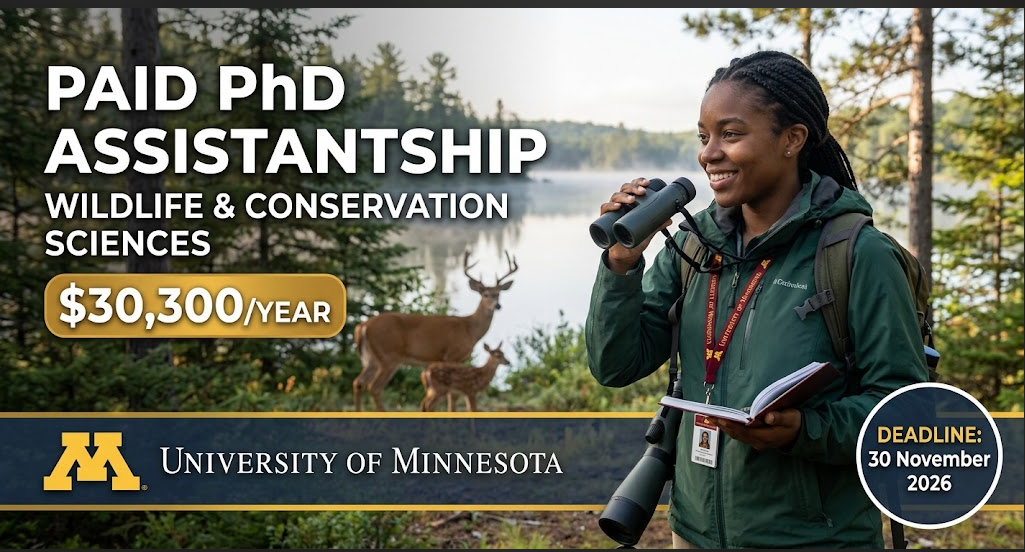
Paid PhD Assistantship in Wildlife and Conservation Sciences at University of Minnesota: $30,300/Year (Deadline: 30 November 2026)
Interested in stock investment? Start here
For wildlife biology and ecology graduates who want to pursue a PhD in deer health and disease ecology in partnership with an Indigenous nation — conducting meaningful, community-engaged field research in northern Minnesota — this assistantship offers both compelling science and an exceptional collaborative context.
The University of Minnesota Conservation Sciences Program is seeking an outstanding PhD student to investigate white-tailed deer health dynamics and disease ecology in partnership with the Fond du Lac Band of Lake Superior Chippewa (FDL Band) and Bemidji State University. The position pays up to $30,300 per year and begins in September 2027.
Application deadline: 30 November 2026.
What the Position Covers
| Component | Detail |
|---|---|
| Annual salary | Up to $30,300 |
| Degree | PhD in Conservation Sciences |
| Hours per week | At least 20 |
| Start date | September 1–7, 2027 |
| Location | University of Minnesota, Saint Paul + field sites in northern Minnesota |
| Supervisor | Dr. Tiffany Wolf |
The Conservation Sciences Program at the University of Minnesota is one of the most respected wildlife and natural resources graduate programmes in the United States — with strong connections to state and tribal wildlife agencies, federal research partners, and a culture of applied, community-engaged research.
The Research: Why This Project Matters
Waawaashkeshi (white-tailed deer in Ojibwe) are a species of profound social, cultural, and economic importance to the Fond du Lac Band of Lake Superior Chippewa. They are also ecologically central to the landscapes of northern Minnesota and the 1854 Ceded Territory — an area shared between tribal and non-tribal hunters and communities.
This research has two interconnected goals:
1. Understanding deer population health dynamics — investigating the relationships between deer management, survival, and health across the Fond du Lac Reservation and surrounding territory. You will generate a comprehensive health dataset covering disease prevalence, population conditions, and ecological risk factors.
2. Disease risk analysis for elk reintroduction — the 1854 Ceded Territory has been proposed as a site for elk reintroduction. Before that happens, it is essential to understand what disease hazards currently exist in the deer population that could affect incoming elk. Your research will directly inform that risk assessment and help protect the success of the elk reintroduction.
What you will actually do:
- Plan and implement substantial fieldwork in northern Minnesota, including deer capture, sampling, and mortality investigations
- Collect and manage large health and ecological datasets
- Conduct laboratory analyses on health samples
- Apply advanced epidemiological and ecological modeling techniques
- Work directly with FDL Band wildlife staff and tribal community members
- Publish peer-reviewed research
This is not a desk-based or primarily computational PhD. It requires genuine commitment to field ecology, sometimes in extreme Minnesota winter and summer conditions.
The Indigenous Partnership Dimension
This project is genuinely collaborative with the Fond du Lac Band, not a university project that happens to occur on tribal land. The FDL Band is a research partner with real investment in the outcomes. Your role requires:
- Deep respect for Indigenous sovereignty and self-determination in research contexts
- Dedication to cultivating respectful, reciprocal partnerships with FDL community members
- Understanding that the knowledge generated belongs to and serves the community, not just the scientific literature
Preference will be given to candidates with Native American heritage and an explicit statement that reflects the project’s commitment to supporting Indigenous scientists in research that directly affects Indigenous communities.
For candidates who are not Native American, this preference does not disqualify you — but your application should demonstrate genuine understanding of and commitment to Indigenous sovereignty and community-based research ethics.
Who Should Apply: Qualifications
Required:
- Bachelor’s degree in wildlife biology, ecology, or a related field
- Strong work ethic and excellent oral and written communication skills
- High attention to detail
- Ability to work independently and with external partners
- Willingness to work long hours in extreme field conditions (heat, cold, insects, rough terrain)
- Positive, collaborative attitude — you will be living and working closely with others in field conditions
Preferred:
- Native American heritage
- Prior field research experience in wildlife ecology, deer biology, or epidemiology
- Experience with community-engaged or tribal partnership research
- Quantitative modeling skills
How to Apply
Step 1: Submit a formal application package through the University of Minnesota Slate system at choose.umn.edu/apply/
Your application must include:
- Cover letter highlighting your experiences and interest in graduate training — specifically address your interest in this project and any relevant field or community partnership experience
- CV or resume
- Unofficial transcripts
- Contact information for three references
Step 2: Contact Dr. Tiffany Wolf at wolfx305@umn.edu for any additional questions about the opportunity.
Application deadline: 30 November 2026
For more information and application:

