
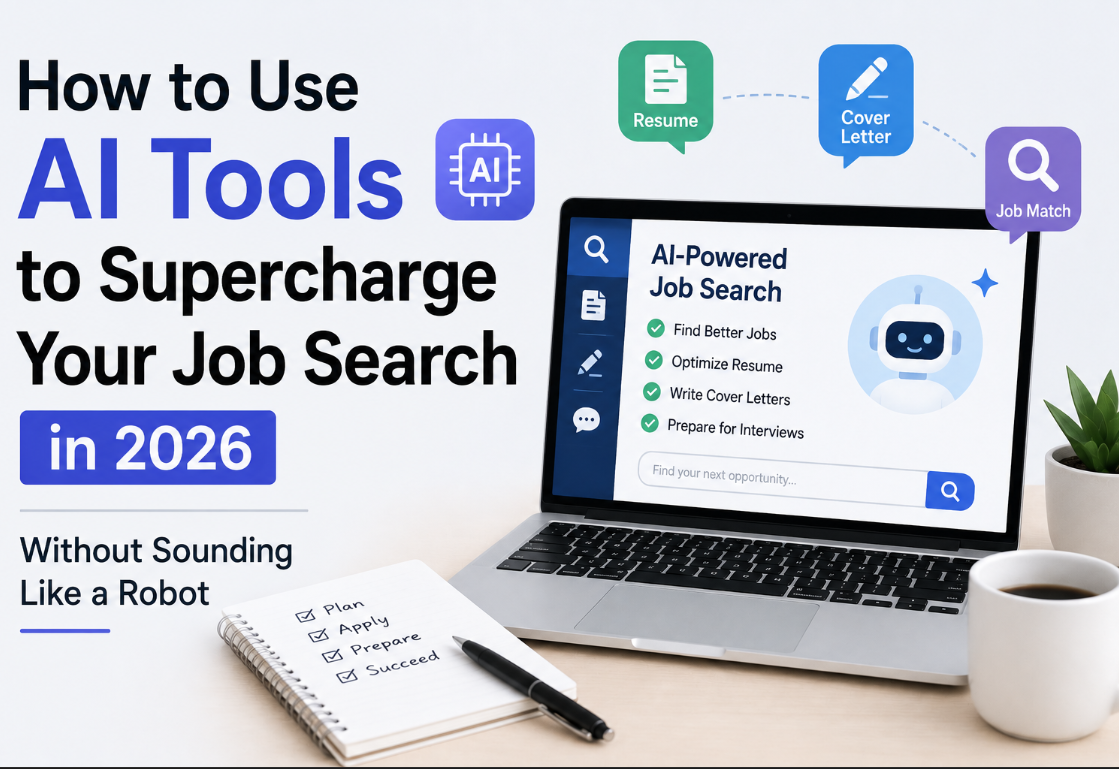
How to Use AI Tools to Supercharge Your Job Search in 2026 — Without Sounding Like a Robot
AI tools have changed the job search in ways that would have felt like science fiction five years ago. You can now research companies in seconds, draft cover letters in minutes, and prepare for interviews with a simulated conversation partner, all for free or close to it.
But there is a problem that nobody talks about honestly. Most people using AI in their job search are producing outputs that sound exactly like AI, flat, generic, and instantly recognisable to any recruiter who reads more than fifty applications a week. Which is every recruiter.
This guide is about using AI to do the heavy lifting on your job search without surrendering the one thing that actually gets you hired: the specific, human, authentic voice that only you have.
The Two Ways AI Can Help Your Job Search
Before getting into specific tools and tactics, it helps to understand the two distinct roles AI can play.
AI as a research and preparation tool. This is where AI is most powerful and most risk-free. Using AI to research a company, understand an industry, prepare for interview questions, or analyse a job description is pure upside, you get better information faster, and your output is still your own.
AI as a writing tool. This is where most people go wrong. AI can help you structure a cover letter, improve clarity, or suggest stronger phrasing, but if you paste the AI’s output directly into your application without meaningful editing, it will sound like AI. Recruiters notice. And it will cost you.
Use AI for the first category freely. Use it for the second category carefully.
1. Researching Companies Before Applying
Before you apply to any role, you should know what the company does, who their customers are, what their recent news is, what their culture is like, and what challenges they are currently facing. This research used to take an hour. With AI it takes ten minutes.
How to do it: Open any AI assistant (ChatGPT, Claude, Gemini) and ask: “Tell me about [Company Name], what do they do, who are their customers, what are their main products, and what have been their significant developments in the last year?” Then follow up with: “What are the main challenges facing companies in the [industry] space right now?”
Use the output as a starting point, then verify the most important facts on the company’s own website and in recent news. AI knowledge has cutoff dates and can occasionally be inaccurate.
Take what you learn and fold it specifically into your cover letter and interview answers. This is the most important use of AI in your job search and the one that directly translates to better applications.
2. Analysing Job Descriptions for Keywords
One of the most valuable things you can do before writing a tailored application is to understand exactly what a job description is prioritising. AI makes this instant.
How to do it: Paste the full job description into an AI assistant and ask: “What are the five most important skills, experiences, or qualities this employer is looking for? What keywords appear most frequently? What does this role seem to prioritise above everything else?”
Then compare the output against your own CV and cover letter. Are your most relevant skills and experiences described using the same language the employer uses? If not, adjust them — honestly, not fabricated.
This technique directly improves your chances of passing Applicant Tracking System (ATS) filters, which scan CVs for keyword matches before a human ever reads them.
3. Drafting and Improving Cover Letters, The Right Way
This is the highest-risk AI use in job searching, and also potentially the most valuable if done correctly. The key is treating AI as a first draft editor, not as the author.
The wrong approach: “Write me a cover letter for a customer success role at Sourcegraph.” Copy the output. Submit it.
The right approach:
- Write a rough draft of your cover letter yourself, even bullet points are fine, capturing the specific experiences, the specific company details, and the specific reasons you want this role.
- Paste your rough draft into an AI tool and ask: “Improve the flow and clarity of this cover letter without changing the specific details, examples, or my personal voice. Do not make it sound generic.”
- Read the output critically. Put back anything that was yours and got lost. Remove anything that sounds generic. Make sure every specific detail is still accurate.
- Read it aloud. If it sounds like something anyone could have written, rewrite it until it sounds like you.
The goal is a letter that reads naturally and specifically, one that could only have been written by you about this company. AI can help you get there faster, but it cannot get you there on its own.
4. Preparing for Interviews With AI Roleplay
This is one of the most underused and most effective applications of AI in job searching. You can use AI as a practice interview partner, available 24 hours a day, infinitely patient, and able to simulate any type of interview question.
How to do it: Paste the job description into an AI tool and say: “Act as a senior hiring manager at this company, conducting a 30-minute interview for this role. Ask me interview questions one at a time, give me feedback on my answers, and point out where I was vague, weak, or unconvincing.”
Then do the interview. Answer the questions out loud or in text. Ask for feedback after each answer. Do this three or four times before the real interview.
This practice technique builds the muscle memory of answering clearly and specifically under pressure, and AI’s feedback, while not perfect, consistently identifies the same weaknesses a real interviewer would notice.
5. Researching Salary Ranges
Before any negotiation, you need to know your market rate. AI cannot give you real-time salary data, but it can point you to the right sources and help you think through your negotiation strategy.
How to do it: Ask AI: “What are the typical salary ranges for a [role title] with [your experience level] at [company type and size] in [location or remote]? What factors typically affect pay in this role?” Then verify against Glassdoor, Levels.fyi, LinkedIn Salary, and PayScale.
Come into every salary conversation with a specific, research-backed number rather than a vague range or no number at all.
6. Writing LinkedIn Connection Messages and Follow-Ups
The brief, professional messages you send when connecting with recruiters or hiring managers on LinkedIn are easy to get wrong, too long, too salesy, or too generic. AI can help you calibrate the tone and length.
How to do it: Describe the situation to an AI tool, who you are, who you are messaging, and why you are reaching out — and ask for a two to three-sentence message that is professional, specific, and human-sounding. Then edit it to remove any phrase that sounds generic (“I came across your profile and was impressed”) and replace it with something specific to that person or company.
7. Generating Questions to Ask at the End of Interviews
Strong questions at the end of an interview signal genuine interest and preparation. AI can help you generate ten to fifteen specific, intelligent questions based on the job description and company, from which you choose the three or four most relevant.
How to do it: Paste the job description and basic company information, and ask: “Generate fifteen thoughtful, specific questions I could ask at the end of an interview for this role that would demonstrate genuine interest and research.”
Filter out anything generic (“What does success look like in this role?” appears on every list) and keep the questions that could only be asked about this specific company and role.
The Golden Rule: Always Edit for Your Voice
Whatever AI produces, your job is to edit it back to sounding like you. The specific way you describe your experience, the particular phrasing you use, the tone you naturally write in, these are what make you identifiable as a human candidate rather than a prompt.
Recruiters who read hundreds of applications a week can spot AI-generated text in seconds. The tell is not any single word; it is the absence of specificity, the vagueness that comes from text generated without real personal experience behind it.
AI is a tool, not a ghostwriter. Use it to work faster. Keep your voice to get hired.
FAQ
Which AI tools are best for job searching? ChatGPT (openai.com), Claude (claude.ai), and Gemini (gemini.google.com) are all free to use at a basic level and are all capable of the tasks described in this guide. Try all three and use whichever produces output that feels most natural to edit.
Will recruiters know I used AI? If you paste AI output directly without editing, yes, many will notice the generic, over-structured phrasing that AI tends to produce. If you use AI as a drafting and research tool and edit heavily for your own voice, no one will know or care.
Is it ethical to use AI in a job application? Using AI to research, prepare, and improve your writing is entirely ethical — it is the same as using a dictionary, a style guide, or a career coach. Misrepresenting AI-generated experience as your own is not. The distinction is whether the content accurately represents you.

