
Digital health is one of the most consequential frontiers in African development. The decisions made in the next decade about how health data is collected, shared, secured, and used will shape health outcomes for hundreds of millions of people across the continent — and the researchers who help make those decisions well will define the field.
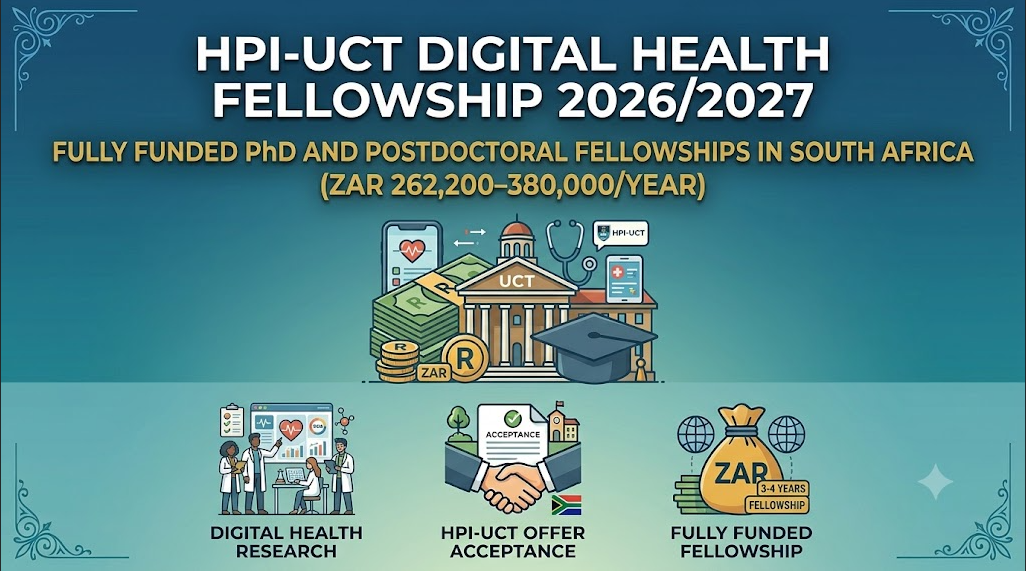
The Hasso-Plattner Institute (HPI) and University of Cape Town (UCT) Digital Health Partnership offer annual PhD and Postdoctoral fellowships specifically for researchers from the African continent working in digital health. Fellowships run for up to three years, are based at UCT in Cape Town, and cover tuition, registration fees, a generous annual bursary, a once-off equipment allowance, and conference travel funding.
Applications for 2026 are rolling but close on 15 August 2026. Applications for 2027 entry also close 15 August (annually).
What Is the HPI-UCT Partnership?
The Hasso-Plattner Institute is a leading German computer science and design thinking institution founded by SAP co-founder Hasso Plattner. Its partnership with the University of Cape Town, one of Africa’s top-ranked research universities, focuses specifically on building African research capacity in digital health.
The fellowship programme is housed across two UCT schools:
School of Information Technology (SIT) — for researchers with backgrounds in Computer Science, Information Systems, and related technical fields.
School of Public Health (SPH) — for researchers with backgrounds in Epidemiology, Biostatistics, Health Systems, Health Economics, clinical disciplines with public health research expertise, and related areas.
This dual-school structure reflects the genuinely interdisciplinary nature of digital health — requiring both technical computing expertise and public health understanding.
What the Fellowship Covers
| Component | PhD Fellows | Postdoctoral Fellows |
|---|---|---|
| Tuition and registration fees | ✅ Fully covered | ✅ Fully covered |
| Annual bursary | ZAR 262,200/year (ZAR 21,850/month) | ZAR 300,000–380,000/year |
| Equipment allowance | Up to ZAR 28,500 (once-off) | Up to ZAR 28,500 (once-off) |
| Conference travel | Up to ZAR 38,000/year | Up to ZAR 38,000/year |
| Maximum duration | Up to 3 years | Up to 3 years |
At current exchange rates, ZAR 262,200 per year for PhD students is approximately $14,000 USD or €13,000, and in Cape Town, where the rand’s purchasing power is strong relative to most international currencies, this stipend covers a comfortable student standard of living. The postdoctoral fellowship of ZAR 300,000–380,000 (approximately $16,500–$21,000 USD) is competitive by African research standards.
The conference travel allowance of ZAR 38,000 per year is particularly valuable — enabling fellows to present their work at international conferences and build global professional networks throughout their fellowship.
Research Areas
Fellows conduct original research in one of the following areas or closely related fields:
- Health Information Exchanges, Normative Standards, Interoperability, Common Data Models
- Electronic Medical and Health Records
- Community Health Worker and patient-focused AI and digital technologies
- AI, AI Ethics, and AI Safety in Health
- Community-driven Digital Health Interventions
- Computational Science
- Digital transformation of the health sector
- Monitoring and evaluation of digital health programmes
- Economic evaluations of digital health solutions
- Population-wide analyses of real-world health data
- Application of novel methods to health data processing or analysis
- Data governance and research engineering
- Natural Language Processing for Digital Health
- Health Systems Processes
- Climate Change and Health
This is an exceptionally broad research remit; if your work touches digital health from any disciplinary angle, there is likely a research home for you in this fellowship.
Who Can Apply: Eligibility
Geography: Open to researchers from the African continent. This is explicitly an African fellowship — designed to build African research capacity at an African institution.
For PhD applicants: Must hold a Master’s degree supported by a strong dissertation. For the School of IT pathway, the Master’s should be in Computer Science, Information Systems, or a related field. For the School of Public Health pathway, it should be in Epidemiology, Biostatistics, Health Systems, Health Economics, a related public health field, or a clinical discipline with public health research expertise.
For Postdoctoral applicants: Must hold a doctoral degree in a relevant field.
English proficiency: Either a TOEFL score of at least 570 (paper-based) or 230 (computer-based), or an overall IELTS band score of 7.0 with no individual element below 6.0. Exempt if your medium of education was English.
Advantageous: A prior track record of peer-reviewed publications. Willingness to support teaching.
Study mode: Full-time, in person in Cape Town. A study visa is required.
Why Cape Town — The Honest Picture
The University of Cape Town consistently ranks as Africa’s top university in global rankings. Cape Town is one of the world’s most beautiful and internationally connected cities — with a strong research ecosystem, a large international academic community, and a quality of life that attracts researchers from across the continent and globally.
The ZAR bursary goes further in Cape Town than a comparable nominal amount would in most European or North American cities — particularly for researchers converting from Nigerian naira, Kenyan shillings, or Ghanaian cedis, where the rand offers meaningful purchasing power.
The primary practical consideration is the study visa requirement — UCT is clear that fellows must secure a South African study visa. Begin this process early if selected, as visa processing can take several weeks.
How to Apply
Submit a single PDF file containing all of the following to the LimeSurvey portal at: https://limesurvey.uct.ac.za/index.php/258499
Required materials:
- Curriculum vitae (2–3 pages)
- Academic transcripts
- TOEFL/IELTS results (if applicable)
- Brief research proposal (2–3 pages) identifying potential UCT supervisors from Computer Science, Information Systems, or Public Health
Your research proposal must:
- Clearly outline your research question(s)
- Describe your proposed methodology
- Name potential supervisors at UCT whose work aligns with yours (consult their web pages and publications, and contact them by email beforehand)
- Fall within the core research areas of available supervisors — proposals outside these areas will not be considered
Shortlisted candidates will be asked to arrange three reference letters and participate in a video conference interview.
Applications for 2026 close: 15 August 2026
Applications for 2027 also close: 15 August annually (for February 2027 start)
Questions: hpi-admin@uct.ac.za
Honest Assessment: Who Should Apply
For African researchers in digital health — whether from a technical computing background or a public health one — this is one of the most valuable fellowship opportunities available on the continent. The combination of a fully covered tuition, a meaningful monthly bursary, equipment support, and conference funding at Africa’s top-ranked university represents a genuinely strong foundation for doctoral or postdoctoral research.
The most important preparation step is identifying and contacting potential supervisors before applying. The programme is explicit that proposals must align with current supervisor research interests — and contacting supervisors in advance dramatically increases the quality and targeting of your proposal. Do this first, before writing anything else.
FAQ
Is this fellowship open to Nigerian and African students?
Yes — the fellowship is explicitly for researchers from the African continent.
Do I need to speak Afrikaans or Zulu?
No. The working language at UCT is English. South African language knowledge is not required.
Can I apply from outside South Africa?
Yes. The fellowship is for African researchers relocating to Cape Town to study. A study visa is required.
What is the application deadline?
15 August 2026 for 2026 entry. 15 August annually for subsequent years.
Where do I submit my application?
Single PDF to https://limesurvey.uct.ac.za/index.php/258499
For more information and application:
Visit the official website of the HPI-UCT Digital Health Fellowship 2026/2027

