
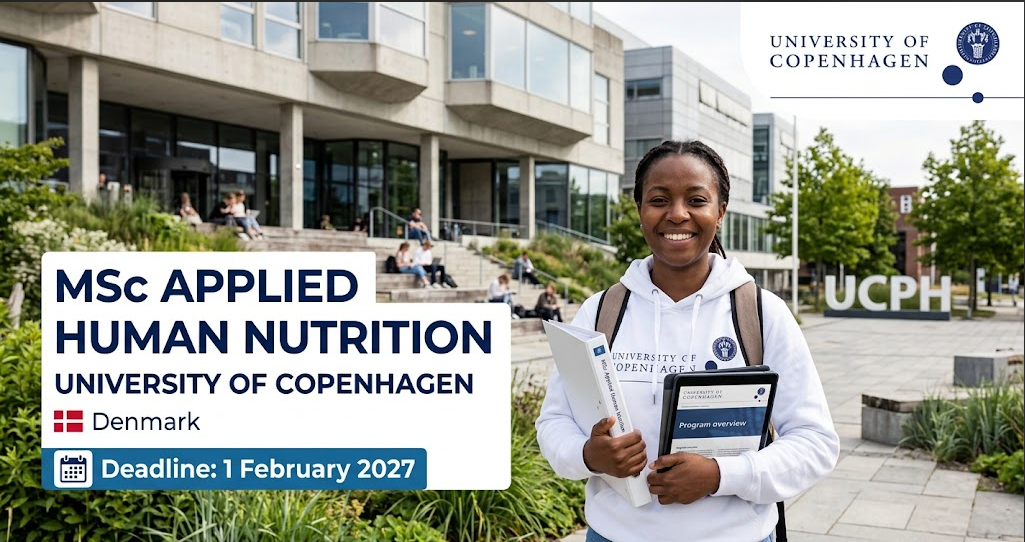
MSc Applied Human Nutrition: University of Copenhagen, Denmark (Deadline: 1 February 2027)
Interested in stock investment? Start here
The Master of Science in Applied Human Nutrition at the University of Copenhagen is a two-year, English-language research-based programme training future nutrition scientists and professionals to address complex food and nutrition challenges, from individual health to sustainable global food systems.
It is taught at one of the world’s most respected life sciences universities, in one of the most livable and socially progressive countries in the world, and for qualifying international students, it may be tuition-free or come with scholarship support.
Applications for the September 2027 intake open on 1 October 2026 and close on 1 February 2027.
What Is the University of Copenhagen?
The University of Copenhagen is Denmark’s largest and most research-intensive university, ranked consistently among the world’s top 100, and among the top 5 in Europe for life sciences. The Faculty of Science, where this programme is housed, is globally recognised for nutrition research, food systems analysis, biochemistry, and public health nutrition.
Copenhagen itself is one of the world’s most livable cities, with a high quality of life, strong English proficiency in the general population, a world-class public transport system, and a culture that values work-life balance in ways that make it an excellent environment for intensive postgraduate study.
What the Programme Covers
The MSc Applied Human Nutrition is a 2-year full-time research-based Master’s, meaning it combines coursework with significant independent research work, culminating in a substantial Master’s thesis.
Core themes:
- Nutritional biochemistry and physiology
- Food and nutrition policy
- Epidemiology and research methodology
- Sustainable food systems
- Diet and chronic disease prevention
- Advanced nutritional assessment methods
Distinctive features:
- Strong integration of basic science, applied research, and public health perspectives
- Access to the University of Copenhagen’s world-class research infrastructure, including the Department of Nutrition, Exercise and Sports (NEXS)
- Collaboration with Danish and international food industry, NGOs, and government health agencies
- Copenhagen’s unique position as a hub for Nordic nutrition research and Scandinavian food culture
Tuition Fees and Scholarships
EU/EEA/Swiss students: No tuition fees at Danish public universities. EU, EEA, and Swiss students study at the University of Copenhagen without paying tuition; only a modest semester registration fee applies.
Non-EU international students: Pay tuition fees of approximately DKK 90,000–140,000 per year (€12,000–€19,000) depending on programme.
University of Copenhagen Scholarships: The university offers a limited number of scholarships to non-EU international students — typically covering full or partial tuition fee waivers. Scholarships are awarded based on academic merit and are competitive. Check the University of Copenhagen’s scholarship database at scholarship.ku.dk for the current available awards and deadlines.
External scholarships: Non-EU students should simultaneously pursue external scholarships. The most relevant for this programme are:
- Danish Government Scholarship: Available to students from selected non-EU countries — check the list of eligible nationalities at study-in-denmark.dk
- Danish University Scholarship: Separate from government funding — consult ku.dk/scholarships
- Erasmus+ Bilateral Agreements: If your home university has an exchange agreement with Copenhagen, partial funding may be available
- Own-country government scholarships: Many scholarship programmes — including DAAD (for German students), and various African and Asian government scholarships — can be used for study at Danish universities
Entry Requirements
Academic: A Bachelor’s degree equivalent to a Danish Bachelor of Science in Human Nutrition, Food Science, Biochemistry, Biology, Chemistry, Pharmacy, Medicine, Veterinary Science, or a related field. Your degree must include a minimum of 15 ECTS (or equivalent) of human or animal nutrition and 15 ECTS in natural sciences (chemistry, biology, physiology, biochemistry, or mathematics/statistics).
If your Bachelor’s does not include the required nutrition credits, specific examples of insufficient backgrounds include: nutrition education focused on counselling/dietetics (not science); food technology or food engineering; public health without adequate science components.
Language: English proficiency required for non-native speakers:
- IELTS Academic: minimum 6.5 overall (no band below 6.0)
- TOEFL iBT: minimum 83
- Cambridge: C1 Advanced or C2 Proficiency
Exemptions: Citizens of Australia, Canada, Ireland, New Zealand, the UK, USA. Also students who completed their previous degree taught in English at an EU/EEA institution.
How to Apply
Applications are submitted through the University of Copenhagen’s online application portal at apply.ku.dk.
Application window: 1 October 2026 – 1 February 2027 at 23:59 CET
Required documents:
- Application form (completed online)
- Bachelor’s degree certificate and official transcripts
- English language proficiency test results (if applicable)
- Course descriptions for relevant Bachelor’s courses (for subject area verification)
- Motivation letter
- CV
For more information and application:
Visit the official website of the MSc Applied Human Nutrition

