
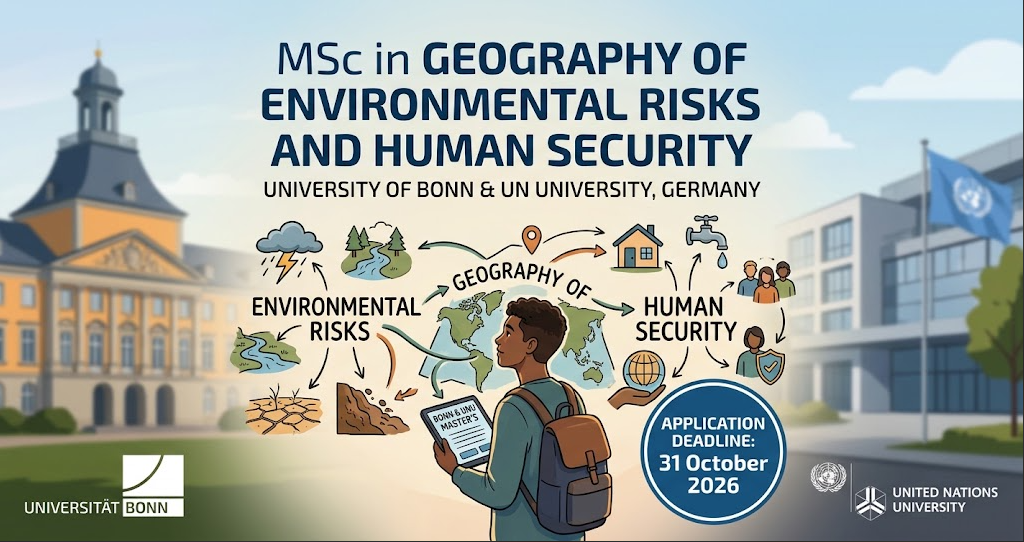
MSc in Geography of Environmental Risks and Human Security: University of Bonn and UN University, Germany (Application Deadline: 31 October 2026)
Interested in stock investment? Start here
There are very few Master’s programmes in the world that combine a leading research university with a United Nations institution for a joint degree. The MSc in Geography of Environmental Risks and Human Security, offered jointly by the Department of Geography at the University of Bonn and the Institute for Environment and Human Security at the United Nations University (UNU-EHS), is one of them.
This two-year Master’s programme provides advanced training in environmental risks, natural hazards, vulnerability, resilience, disaster management, and human security — with a strong focus on developing countries and the Global South. Since its launch in 2013, 279 students from 46 countries have studied in the programme.
Applications for the October 2027 intake are accepted from 31 July to 31 October 2026.
What the Programme Covers
The two-year programme consists of 12 modules, 10 taught across the first three semesters, followed by a compulsory 8-week internship and an independent Master’s thesis.
Fields of study include:
- Geographical approaches to risk, vulnerability, and resilience
- New approaches to development geography
- Earth system science
- Qualitative and quantitative methods, GIS and Remote Sensing
- Social-ecological systems, risk and technology
- Risk management, governance, forecast and prediction
- Disaster management, disaster risk reduction, and humanitarian response
Specialist expertise covers: Vulnerability Assessment, Ecosystem Services, Sustainable Development, Disaster Management, Climate Change Adaptation, Human-Nature Relationships, Science and Technology Studies, Development Geography, Geomorphology, Socio-Hydrology, Future Studies, GIS and Remote Sensing.
The programme’s close cooperation with the UN system and international organisations provides exceptional career exposure across disaster risk reduction, humanitarian aid, climate change research, food security, spatial planning, and policy.
Who Can Apply: Requirements
Academic: A Bachelor’s degree in Geography or a closely related field. The majority of your attended courses must relate to: Human Geography and Social Sciences (spatial patterns, society, development); Science methodology and empirical research methods; and Physical Geography, Geosciences and Environmental Sciences.
The programme is not designed for graduates in Engineering-related subjects or International Relations unless their profile relates strongly to environmental risks.
English proficiency: Required for all non-native speakers, unless from Australia, Canada, Republic of Ireland, New Zealand, UK, or USA. Accepted certificates: TOEFL (550/79 iBT/213 CBT), IELTS (6.5), Cambridge CAE (≥B2), PTE Academic (67), Duolingo (120).
Motivation: A strong commitment to contributing to human security and environmental risk management is essential. The programme attracts students who want to work in international organisations, NGOs, government agencies, and research institutions.
Scholarship Funding: DAAD EPOS
The programme is part of the DAAD EPOS scheme — which offers fully funded scholarships to students from eligible developing countries (including many African nations).
To be eligible for DAAD EPOS funding, you must additionally:
- Be from an eligible developing country (check the DAAD website for the current list)
- Have at least 2 years of relevant work experience since your Bachelor’s graduation by the time of application
- Have graduated from your last academic degree no more than 6 years ago
- Not have completed another Master’s degree in a similar field
- Aim to pursue a career as a practitioner in development (not pursuing a PhD)
- Not have been in Germany for more than 15 months at the application closing date
EPOS scholarship applicants must submit additional documents — including the DAAD EPOS application form, work certificates (totalling at least 2 years), a professional reference, and the EPOS checklist.
Programme admission does not guarantee a DAAD EPOS scholarship. Selection for the scholarship happens separately between February and April.
Candidates from developing countries who do not meet EPOS criteria are encouraged to apply for other German scholarships, including the Friedrich Ebert Foundation, Heinrich Böll Foundation, Konrad Adenauer Foundation, and others.
The Academic Writing Sample: Important for 2027 Applicants
For the 2027 intake, all applicants must submit an academic writing sample responding to the following prompt:
“How has your own academic or professional experience influenced the areas of focus you plan to pursue in your studies? Please elaborate on 1) your own experiences, 2) how you would like to bring them into your planned thesis work, and 3) why you think that perspective could help close a research gap.”
Requirements:
- Maximum 1,000 words excluding references
- Written in English
- Academic essay style with up to 10 references (APA format)
- Must state: “I confirm to have written the essay myself, without the use of AI”
- Plagiarism and AI checks may be applied
- Submitted as a separate PDF alongside your application package
How to Apply
Applications are submitted by email to master-georisk@ehs.unu.edu as a single PDF package (maximum 8MB) in a specific document order. The academic writing sample is submitted as a separate file.
Application package must include (in this order):
- Online application form (completed and signed)
- Motivation letter (1–2 pages, dated)
- CV in EUROPASS format (max 3 pages, dated)
- Degree certificate(s) and transcripts
- English language proficiency certificate
- Academic references (optional, max 2)
- Copy of passport
- Other relevant references (optional, max 3)
- APS Certificate (China, India, Vietnam applicants only)
For DAAD EPOS applicants, additionally: EPOS checklist, DAAD application form, scholarship motivation letter, professional reference from current employer, work certificates.
Application period: 31 July – 31 October 2026
For more information and application:
Visit the official website of the MSc in Geography of Environmental Risks and Human Security

