
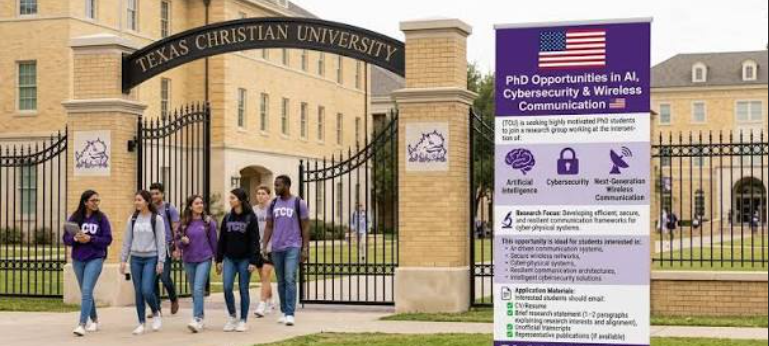
Texas Christian University (TCU) is recruiting one fully funded PhD student in AI, cybersecurity, and next-gen wireless networks for Fall 2026 or Spring 2027. Tuition and stipend fully covered. Here’s how to apply.
Overview
If you’re a computer science or engineering graduate with a strong interest in artificial intelligence, cybersecurity, or wireless networks — and you’ve been looking for a funded PhD opportunity in the United States — this position deserves your immediate attention.
A faculty researcher in the Department of Computer Science at Texas Christian University (TCU) is actively recruiting one highly motivated PhD student to join their research group for Fall 2026 or Spring 2027. The admitted student receives full funding — tuition covered plus a stipend — through a research or teaching assistantship.
One seat. Full funding. Research at the cutting edge of AI and cybersecurity. And an explicit invitation from the professor to apply even if you don’t tick every box on the qualifications list.
Application is by direct email to the faculty member. There’s no centralised portal, no bureaucratic waiting list. If you move fast and reach out with a strong application package, you’re directly in the conversation.
About the Research
This PhD sits at the intersection of three of the most consequential technology fields of the next decade: artificial intelligence, cybersecurity, and next-generation wireless communication.
The faculty member’s research focuses on building secure, interpretable, and real-time communication frameworks for cyber-physical systems — the class of systems where software, sensors, and physical infrastructure are deeply integrated. Think autonomous vehicles communicating with road infrastructure, smart grids managing energy distribution in real time, or IoT networks coordinating industrial equipment.
The research uses deep learning, large language models (LLMs), and vision-language models (VLMs) to improve how these systems communicate efficiently and securely — and specifically integrates Explainable AI (XAI) to ensure that AI-driven decisions in safety-critical environments can be understood, audited, and trusted.
This is not theoretical computer science for its own sake. It’s research designed to make the AI-enabled physical world safer, more efficient, and more interpretable for the humans who depend on it.
Research Areas — What You’ll Work On
As a PhD student in this group, your work will sit across two categories of focus:
Core Technical Areas
- Next-Generation Wireless Communication — 5G/6G architectures, protocol design, and performance optimisation
- Semantic Communication — AI-driven communication systems that transmit meaning rather than just raw data
- Communication Security — protecting wireless and network systems from adversarial attacks and interference
- Explainable AI (XAI) — making AI decision-making transparent and interpretable in safety-critical deployments
- Deep Reinforcement Learning (DRL) — training AI agents to make sequential decisions in dynamic network environments
- Large Language Models (LLMs) — applying and adapting transformer-based language models to network and security tasks
- Vision-Language Models (VLMs) — multimodal AI systems that process both visual and linguistic information
Application Domains
- Internet of Vehicles (IoV) — secure communication between connected and autonomous vehicles
- Internet of Things (IoT) — networked device ecosystems in industrial and consumer settings
- Smart Grid / Energy Systems — AI-managed energy distribution and cybersecurity for critical infrastructure
- Autonomous Vehicles — real-time, safety-critical communication and decision-making systems
If you’ve been following the AI and cybersecurity space — or if you’ve been building skills in deep learning, network security, or wireless systems — this is the kind of research group where those skills get applied to problems that genuinely matter.
Who Should Apply?
The faculty member is explicit about this: you don’t need to check every box. If the research genuinely excites you and you’re willing to learn, you are encouraged to reach out.
Minimum Qualifications (Required)
- A Bachelor’s degree in Computer Science, Computer Engineering, Electrical Engineering, or a closely related field
- Solid Python programming skills
- Foundational knowledge of computer networks
- Foundational knowledge of machine learning
- Familiarity with deep learning frameworks — PyTorch, TensorFlow, or similar
- Strong analytical thinking and the ability to learn new tools and concepts independently
- Good written and verbal English communication skills
Preferred Qualifications (Not Required — But Strengthen Your Application)
- First-author publication(s) in peer-reviewed venues
- Hands-on experience with DRL, LLMs, VLMs, or transformer-based architectures
- Experience with network simulators — ns-2/ns-3, OMNeT++, or similar tools
- Background in cybersecurity and wireless communications
- A Master’s degree in a related field
- C/C++ programming experience
- GRE scores (not mandatory, but noted as a plus)
The bar for reaching out is deliberately low. A Bachelor’s degree, Python skills, some machine learning foundation, and genuine enthusiasm for the research direction is enough to make contact. The professor isn’t looking for a finished researcher — they’re looking for someone curious and driven enough to become one.
What You Get (Funding Package)
| Benefit | Details |
|---|---|
| Tuition | Fully covered through assistantship |
| Stipend | Included through research or teaching assistantship |
| Funding type | Research Assistantship (RA) or Teaching Assistantship (TA) |
| Start dates | Fall 2026 or Spring 2027 |
| Positions available | One (1) |
The exact stipend amount is not specified in the listing — this is common for direct faculty recruitment posts where the rate is confirmed during the offer process. TCU PhD assistantship stipends are typically competitive with peer institutions and are structured to cover living costs in Fort Worth, Texas, where the cost of living is significantly lower than in coastal US cities.
About Texas Christian University (TCU)
Texas Christian University is a private research university located in Fort Worth, Texas — a city of approximately 950,000 people, adjacent to Dallas, in one of the fastest-growing metropolitan areas in the United States.
TCU is consistently ranked among the top 100 national universities in the US and has a strong and growing research profile in computer science and engineering. Its Department of Computer Science is expanding its graduate research capacity, which is precisely why this kind of individual faculty recruitment is happening — this is a research group being actively built, which means the PhD student who joins now has the opportunity to be a foundational presence.
Fort Worth itself offers an affordable, high-quality urban lifestyle — strong job market (particularly in technology, defence, aerospace, and energy), excellent food and culture, proximity to Dallas’s major corporate and tech ecosystem, and relatively low cost of living compared to other major US metros. For international PhD students, the Dallas-Fort Worth metro area is one of the more welcoming and economically dynamic environments in the country.
Why This Matters for Nigerian and African Students
Funded PhD positions in the US in AI and cybersecurity are competitive and often opaque — most listings go through centralised university portals with no direct faculty contact until late in the process. This position is different. It’s a direct call from a faculty member actively building a research group, with an explicit email address, a clear subject line format, and an invitation to reach out even if you’re not sure you fully qualify.
For Nigerian students especially — many of whom have strong Computer Science and Electrical Engineering backgrounds from institutions like UNILAG, OAU, Covenant, UNIBEN, ABU, or FUTA — this is the kind of opportunity where a well-targeted, well-written email can open a door that a centralised application might not.
A US-based PhD in AI and cybersecurity from a private research university, fully funded, in the fastest-growing technology corridor in America, is a career-defining outcome. The combination of AI, cybersecurity, and wireless networks is precisely where industry and government hiring is concentrated — in the US, in Europe, and increasingly in Africa.
Beyond academia: PhD graduates in this space move into roles at FAANG companies, defence contractors, cybersecurity firms, and international research organisations. The skills built in this programme are some of the most transferable in the technology sector.
How to Apply
The application goes directly to the faculty member by email. There is no portal. Follow these instructions exactly.
Email address: afia.anjum70@gmail.com
Subject line format (copy this exactly, filling in your details):
Prospective PhD Student — [Preferred Semester] [Preferred Year] — [Your Last Name]
Example: Prospective PhD Student — Fall 2026 — Okafor
Attach the following:
- Your CV or resume — include academic background, technical skills, programming languages, frameworks, research experience, and any publications
- A brief research statement (1–2 paragraphs) — describe your research interests and specifically how they align with this faculty member’s work
- Unofficial academic transcript(s)
- Representative publication(s), if you have any
Tips for a Strong Application Email
Your Research Statement (Most Important)
This is your first impression — and in a direct faculty recruitment like this, it matters more than anything else you send.
Do not write a generic statement about loving AI or wanting to do a PhD. The faculty member will read many of those. Write something specific:
- Reference one or two specific aspects of the research that genuinely interest you — semantic communication, XAI in autonomous systems, LLM-based network security, or another specific thread from the research description
- Briefly explain what relevant background you bring — a course, a project, a thesis chapter, a tool you’ve worked with
- Be honest about what you don’t yet know but want to learn — this is not a weakness in a 1–2 paragraph statement; it’s intellectual honesty
Two focused, specific paragraphs will outperform a polished but generic one-page statement every time.
Your CV
List your programming skills explicitly — not just “Python” but which libraries and frameworks you’ve used. If you’ve built anything with PyTorch, TensorFlow, Keras, Hugging Face, or similar, name the specific projects. If you’ve done any coursework or independent work in networking, cybersecurity, or wireless systems, make it visible.
Timing
The position is for Fall 2026 or Spring 2027, with an application deadline of 30 September 2026 for Fall and presumably earlier for Spring. Reaching out early — before the position is filled — is strongly advisable. One position means one offer. Don’t wait.
Key Details at a Glance
| Detail | Info |
|---|---|
| University | Texas Christian University (TCU), Fort Worth, Texas, USA |
| Department | Computer Science |
| Research Focus | AI, Cybersecurity, Next-Gen Wireless Networks, LLMs, XAI |
| Positions | One (1) PhD student |
| Funding | Full tuition + stipend (RA or TA) |
| Degree Required | Bachelor’s in CS, CE, EE, or related field |
| Master’s Required | No (preferred but not required) |
| Start Dates | Fall 2026 or Spring 2027 |
| Application Deadline | 30 September 2026 |
| How to Apply | Email afia.anjum70@gmail.com with specified subject line |
| Open to International Students | Yes |
Apply Now
Email your application to afia.anjum70@gmail.com using the exact subject line format:
Prospective PhD Student — [Preferred Semester] [Preferred Year] — [Your Last Name]
Include your CV, research statement, transcript, and any publications.
There is one seat. The professor is actively looking. If AI, cybersecurity, and wireless networks are your domain — or the domain you want to grow into — this is the email worth sending today.
And if this isn’t your fit but you know a CS or EE graduate who’s been looking for a funded PhD path into AI research in the US, share this with them. One well-timed email could be the beginning of their entire career trajectory.
For more information and application:

