
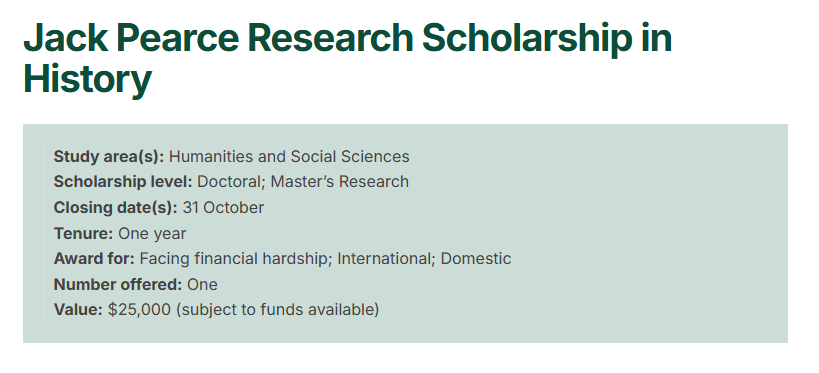
Jack Pearce Research Scholarship in History: $25,000 for Master’s and PhD Students at Victoria University of Wellington, New Zealand
Behind every scholarship is a story. The Jack Pearce Research Scholarship in History has one of the most human ones you will find in academic funding.
Jack Pearce was born in 1911. As a young man, he wanted to go to university, but he never could. There were no grants. His father, reasoning that Jack and his five brothers had all built successful lives with only a secondary education, saw no need for further study. Jack lived his whole life with that unrealised ambition.
When Jack died in 1994, his daughter Brenda Joyce established a scholarship in his memory at Te Herenga Waka, Victoria University of Wellington in New Zealand. Her wish was simple: that young people would have the opportunities for further education that her father had always wanted but never received.
The result is a $25,000 scholarship for Master’s by thesis or PhD students conducting research in History at one of the Pacific region’s most respected research universities. It is open to both domestic and international students, available to part-time researchers on a pro-rata basis, and takes financial need into account when distinguishing between equally qualified candidates.
The closing date is 31 October annually. This post covers everything you need to know.
What Is the Jack Pearce Research Scholarship?
The scholarship is administered through the Victoria University of Wellington Foundation and offered annually, subject to funds available, to one student conducting postgraduate research in History at Victoria University of Wellington.
It is a one-year award with a total value of $25,000 NZD (subject to funds available), structured as follows:
| Component | Amount |
|---|---|
| Tuition fee contribution | $20,000 NZD |
| Direct student stipend | Remainder (approximately $5,000 NZD) |
| Total value | $25,000 NZD |
| Duration | One year |
| Number awarded | One per year |
The split between tuition coverage and direct stipend means the scholarship simultaneously reduces your academic cost burden and provides a modest living contribution, a more practical structure than awards that cover only one or the other.
What Is Victoria University of Wellington?
Te Herenga Waka, Victoria University of Wellington (commonly known as Victoria University of Wellington or VUW) is New Zealand’s capital city university, located in Wellington, the political, cultural, and creative heart of New Zealand.
VUW is one of New Zealand’s eight universities and is consistently ranked among the top universities in the world for its research output. Its humanities and social sciences faculties, particularly History, Law, Political Science, and International Relations, are among its strongest and most internationally recognised departments.
The School of History at VUW has a strong research culture across a broad range of historical specialisations, including New Zealand and Pacific history, colonial and imperial history, political history, cultural history, and global history. The department’s position in Wellington, the seat of New Zealand’s government, home to the national archives, and a hub of Māori political and cultural life, gives historians particular access to primary sources and policy contexts that are unique.
Wellington itself is a compact, highly livable city with a vibrant cultural scene, excellent cafe culture, and a cost of living lower than Auckland or Sydney. For international researchers, it is an excellent base for a year of focused scholarship.
Who Can Apply: Full Eligibility
The eligibility criteria are broader than many history scholarships of comparable value.
Programme level: You must be enrolled as a Master’s by thesis or PhD student in History. Note the important preference: the scholarship committee gives preference to Master’s by thesis students. PhD applicants are only considered if no suitable Master’s applicant is available. If you are a Master’s student, this preference works significantly in your favour.
University: Your research must be conducted at Te Herenga Waka, Victoria University of Wellington. This is a firm requirement; the scholarship is specifically tied to this institution.
Transferring students: Students who intend to transfer to VUW from another university are explicitly eligible to apply. You do not need to already be enrolled at VUW when you apply; you can apply while transferring, as long as enrolment at VUW is confirmed within the scholarship’s tenure conditions.
Domestic and international students: Both are eligible. This is an open international scholarship; New Zealand citizenship or permanent residency is not required.
Part-time students: Part-time researchers are eligible and can be supported on a pro-rata basis. The pro-rata decision is made by the deciding panel. If you are considering part-time study, discuss this with the Scholarships Office before applying.
Financial hardship: The scholarship explicitly notes that where it is difficult to distinguish between candidates on academic merit, financial need may be taken into account. This is a meaningful inclusion — it signals that the scholarship’s origins (in the memory of a man who could not study due to financial constraints) are reflected in how it is awarded.
Selection Criteria: What the Committee Is Looking For
Primary criterion, academic merit: Selection is made primarily based on academic excellence and the university’s ability to supervise your proposed research. A strong academic record in History at the undergraduate level is the foundation. For PhD applicants (who are only considered if no suitable Master’s applicant applies), an additional level of research track record is expected.
Supervisory capacity: The university’s ability to supervise your proposed research is explicitly a selection factor. This means your research topic needs to align with the expertise of the current History faculty at VUW. Before applying, browse the faculty profiles on the VUW History department page and confirm that at least one academic is a credible supervisor for your proposed research area. Ideally, make contact with a potential supervisor before submitting your application.
Financial need as a tiebreaker: Where the committee cannot distinguish between candidates on merit, financial need is considered. If you are experiencing genuine financial hardship, completing the financial information section of the application honestly and fully is important — it could be the deciding factor in a competitive field.
Preference for Master’s students: PhD applicants should note that the committee explicitly prefers Master’s by thesis candidates. PhD applications are only assessed if no suitable Master’s applicant is found. This does not mean PhD students should not apply, but it is an honest context about the relative likelihood of selection.
Required Application Materials
The scholarship has specific documentation requirements beyond the standard application form. Every item must be received by 4:30 pm on the closing date — not submitted by you, but received by the Scholarships Office. This is important for references, especially requesting them well in advance.
1. A brief description of the research topic. This is not a full research proposal; it is a concise description of the historical research you intend to undertake. It should cover: what your research question is, why it matters historically, what sources or methodologies you will use, and why VUW is the right place to conduct this research. Keep it focused and specific; committees respond to clarity of research vision, not breadth of ambition.
2. A personal statement. Your personal statement should explain who you are as a researcher, why History matters to you, what drew you to your specific research area, and how this scholarship would enable you to pursue your research goals. Given the scholarship’s origins — Jack Pearce’s unfulfilled dream of university education, a statement that reflects genuine intellectual passion and a sense of what this opportunity means is entirely appropriate.
3. Financial information section: Complete this section of the online application honestly and fully. As noted above, financial need can be a tiebreaker. Provide accurate information, this section is taken seriously by the committee.
4. One reference A single academic or professional reference requested through the online application system. Choose someone who can speak specifically to your academic ability in History and your research potential. A supervisor from your undergraduate or previous postgraduate work is the strongest choice.
How to Apply: Step by Step
Step 1: Ensure you are enrolled or in the process of enrolling as a Master’s by thesis or PhD student in History at VUW.
Step 2: Applications typically open one month before the closing date, so approximately 1 October. Check the VUW scholarships page for the application link closer to October. If no link is available yet, check back in October or contact the Scholarships Office directly.
Step 3: Complete the online application form in full, including the financial information section.
Step 4: Prepare and upload your research topic description and personal statement.
Step 5: Request your reference through the online system — do this early, giving your referee several weeks to respond before the deadline.
Step 6: Confirm that all materials, including the reference, are received by 4:30 pm on 31 October. Late or incomplete applications are not accepted under any circumstances.
Key Dates
| Milestone | Date |
|---|---|
| Applications open | Approximately 1 October (one month before closing) |
| Application closing date | 31 October at 4:30 pm |
| Award notification | Via the Head of History |
The scholarship cannot be deferred to a later year. If you are awarded it and your circumstances change, you cannot move the award to the following year; plan your application timing accordingly.
Important Conditions to Know Before Applying
Cannot be held with other major scholarships: The Jack Pearce Scholarship may not be held in conjunction with other major postgraduate scholarships. If you are already holding a major award, you are ineligible. Check carefully if you are currently funded by another significant scholarship.
Enrolment condition: All offers are conditional on enrolment at VUW within the scholarship’s tenure. No payment is made until this is confirmed.
Withdrawal repayment: If you withdraw from VUW during the scholarship tenure or fail to make satisfactory progress, partial repayment is normally expected. Advise the Scholarships Office immediately if your circumstances change.
Ambassador responsibilities: Recipients are expected to act as ambassadors for VUW and participate in appropriate events or marketing activities if requested. This is a standard condition at scholarship-funded universities and is not onerous.
Thank you letter and progress report: Recipients must write a letter of thanks to the donor family and submit an end-of-year progress report. Given the personal story behind this scholarship, writing this letter is genuinely meaningful, not just a formality.
Writing a Strong Research Topic Description
The brief description of your research topic is where your application either engages or loses the committee. Here is how to make it work.
Start with the question, not the context. Do not spend three sentences establishing historical background before you tell the reader what your research is actually about. Lead with your specific research question — then provide context.
Be specific about sources and method. What primary sources will you work with? What archives? What methodology — social history, cultural history, digital history, oral history? Specificity signals that you have thought seriously about how your research will actually be conducted.
Connect to VUW’s supervisory capacity. Mention the area of History expertise at VUW that aligns with your topic. If you have already identified a potential supervisor, you can note this without making it a formal commitment. The committee is assessing whether the university can support your work — help them see that it can.
Say why it matters. A brief, honest articulation of why your research question is historically significant — what gap in the existing literature it addresses, what conversation it contributes to — rounds out a strong research description.
Honest Assessment: Is This Scholarship Worth Pursuing?
For History researchers who are genuinely committed to postgraduate study in New Zealand, yes, this is a meaningful award from a university with a strong History department, in a city with excellent archival access and a vibrant intellectual environment.
The $25,000 value, split between tuition coverage and a student stipend, provides real financial support for a year of research that would otherwise be self-funded. The international eligibility makes it accessible to History researchers worldwide. The preference for Master’s by thesis students means the realistic competition pool for most applicants is smaller than it would be if PhD applicants were equally considered.
The scholarship’s personal story also matters. Jack Pearce and his daughter Brenda Joyce wanted this award to give people the opportunities they never had. Writing an application that is honest, passionate, and specific — that reflects genuine engagement with History and genuine gratitude for the opportunity — is entirely consistent with what the scholarship was created to do.
One realistic note: the scholarship is not awarded if no suitable candidate is found in a given year. This reflects a committee that takes quality seriously — which means a strong, specific, well-prepared application is genuinely important. Do not submit a generic application to a scholarship with this kind of personal history.
FAQ
Is this scholarship open to international students? Yes. Both domestic and international students are explicitly eligible.
Can I apply if I am transferring from another university? Yes. Students intending to transfer to VUW from another institution are explicitly eligible.
Is the scholarship available for PhD students? PhD applicants are only considered if no suitable Master’s by thesis applicant is available. Master’s students are strongly preferred.
Can I hold this alongside another scholarship? No. The scholarship may not be held in conjunction with other major postgraduate scholarships.
What is the value of the scholarship? $25,000 NZD (subject to funds available), of which $20,000 goes toward tuition fees and the remainder is paid directly to the student as a stipend.
What is the closing date? 31 October at 4:30 pm each year. Late or incomplete applications are not accepted.
Can I defer the scholarship if I am awarded it? No. The scholarship cannot be deferred to a later year.
What happens if I withdraw from VUW? Partial repayment of the scholarship is normally expected. Advise the Scholarships Office immediately if your circumstances change.
Where do I apply? Through the online application system on VUW’s scholarships page. Applications typically open one month before the closing date — approximately 1 October. Visit victoria.ac.nz/scholarships or contact the Scholarships Office directly.
For more information and application:

