
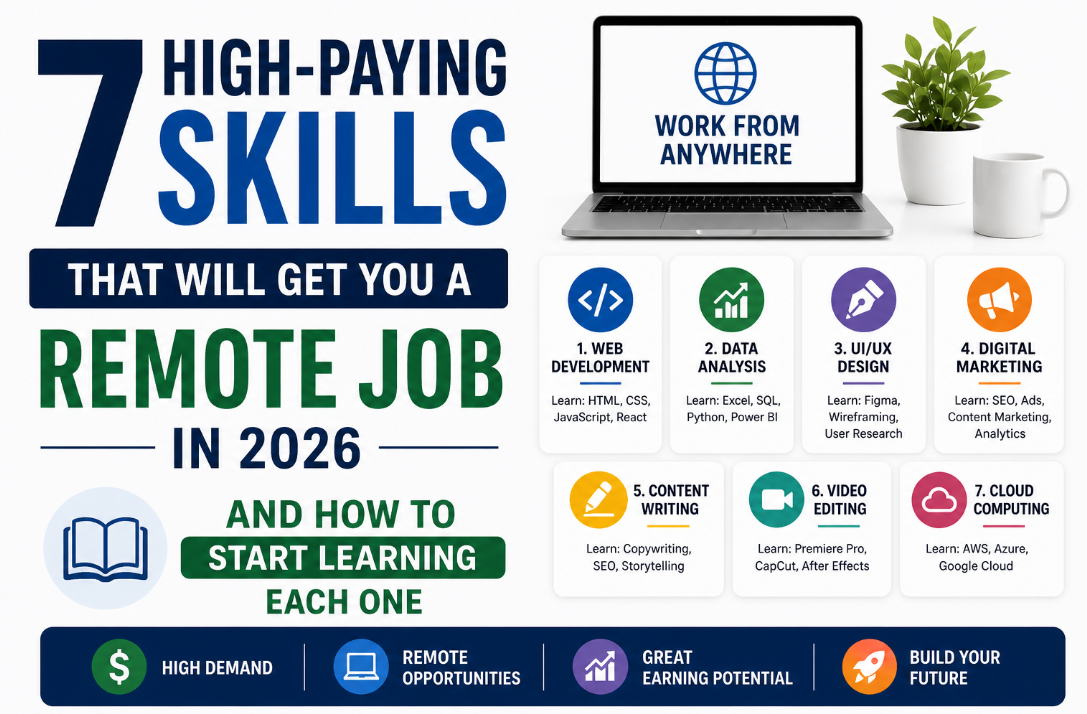
7 High-Paying Skills That Will Get You a Remote Job in 2026 — And How to Start Learning Each One
The remote job market in 2026 rewards specific skills significantly more than others. Some abilities that were valuable five years ago have been partially automated. New ones have emerged. And several that were always valuable have become dramatically more in demand as remote work has become the global default.
This post covers the seven skills that are paying the most in remote work right now, what they are, what the realistic earning potential looks like, and how to start building them even if you are starting from zero.
What Makes a Skill “High-Paying” in Remote Work?
Three factors consistently determine whether a skill commands premium remote pay:
Scarcity. If everyone has the skill, it does not command a premium. The skills that pay the most are the ones where demand consistently outpaces supply.
Business impact. Skills that directly affect revenue, either by generating it, protecting it, or enabling the systems that produce it, are valued more than skills that support peripheral functions.
Transferability. Skills that work across industries and company sizes are more valuable than niche skills that only apply in one context. Remote employers are hiring across sectors — skills that travel well command more.
1. AI Prompt Engineering and AI Workflow Design
Average remote salary range: $70,000 — $150,000+ USD
Barrier to entry: Medium, no degree required, but requires structured learning
Time to job-ready: 3–6 months with focused effort
AI prompt engineering, the ability to design, test, and optimise inputs to large language models like GPT-4, Claude, and Gemini, has gone from a niche curiosity to a mainstream professional skill in 24 months. Companies across every sector are integrating AI tools into their workflows and need people who understand how to make those tools produce useful, reliable, and safe outputs.
Beyond basic prompting, AI workflow design, building systems that chain multiple AI tools together to automate complex processes, is commanding even higher rates. If you can design an AI-assisted content pipeline, a customer support automation system, or a research summarisation workflow, you are solving a problem that most companies currently have, and very few people can help them with.
How to start: Anthropic, OpenAI, and Google all publish free documentation and guides on prompt engineering. DeepLearning.AI offers free and affordable short courses on prompt engineering and AI workflow design.
2. Data Analysis and Business Intelligence
Average remote salary range: $55,000 — $120,000 USD
Barrier to entry: Medium — SQL and Excel are learnable; Python takes longer
Time to job-ready: 4–8 months
Every company generates data. Very few companies have enough people who can turn that data into decisions. Data analysts and business intelligence professionals bridge that gap — taking raw numbers and producing insights that guide business strategy, product development, marketing spend, and operational efficiency.
The core tools are SQL (for querying databases), Excel or Google Sheets (for manipulation and basic analysis), and either Python or a BI tool like Tableau or Power BI (for visualisation and more complex analysis). You do not need to master all of these to get a first data role; SQL plus Excel plus one visualisation tool is a viable entry package.
How to start: Google’s free Data Analytics Certificate on Coursera covers SQL, Excel, Tableau, and R across six months of self-paced learning. Mode Analytics and W3Schools both offer free SQL practice environments.
3. Cybersecurity
Average remote salary range: $65,000 — $140,000+ USD
Barrier to entry: Medium-high, requires technical foundation
Time to job-ready: 6–12 months
Cybersecurity is one of the most significant talent shortages in the global technology industry. The demand for cybersecurity professionals is growing faster than the supply of trained practitioners. maning the barrier to entry is lower relative to compensation than in most other technical fields.
Entry-level roles in cybersecurity, security operations centre (SOC) analyst, information security analyst, penetration testing junior roles, are accessible to candidates with relevant certifications and practical knowledge, even without a computer science degree.
How to start: IBM’s free Cybersecurity Analyst Certificate on Coursera, CompTIA Security+ (the most recognised entry-level cybersecurity certification), and TryHackMe (a free platform for hands-on cybersecurity practice) are the three starting points most recommended by working cybersecurity professionals.
4. Full-Stack Web Development
Average remote salary range: $60,000 — $130,000 USD
Barrier to entry: High — requires sustained learning over 12+ months
Time to job-ready: 12–18 months for most self-taught learners
Full-stack development, the ability to build both the visible front end and the underlying back end of web applications, remains one of the most consistently in-demand skills in the remote job market. Companies at every stage of growth need developers, and remote-first technology companies hire globally.
The standard entry-level full-stack path in 2026 runs through HTML/CSS, JavaScript, React (for front end), Node.js or Python (for back end), and SQL or a NoSQL database. Getting to job-ready requires 12 to 18 months of serious, consistent learning, but the earning potential and career longevity of the skill justify the investment.
How to start: The Odin Project is a free, comprehensive full-stack curriculum with a strong community. freeCodeCamp is another free resource covering the full path from HTML to JavaScript to back-end development.
5. Digital Marketing and SEO
Average remote salary range: $45,000 — $100,000 USD
Barrier to entry: Low-medium — learnable without a technical background
Time to job-ready: 3–5 months
Digital marketing, particularly search engine optimisation (SEO), paid advertising (Google Ads, Meta Ads), email marketing, and content strategy, is one of the most accessible high-paying remote skill sets available. Companies of all sizes need online visibility, and the professionals who can deliver it are consistently in demand.
SEO specifically has seen increased value as AI-generated content floods the internet, companies need people who understand how to produce content that genuinely ranks and genuinely serves readers, not just content that ticks algorithmic boxes.
How to start: HubSpot Academy’s free certifications in content marketing, email marketing, and inbound marketing are the best free starting point. Google’s free SEO Starter Guide and the Ahrefs blog (which publishes extensive free SEO education) are essential supplementary reading.
6. UX/UI Design
Average remote salary range: $55,000 — $110,000 USD
Barrier to entry: Medium — requires design sensibility and tool proficiency
Time to job-ready: 4–8 months
User experience (UX) and user interface (UI) design, the discipline of designing digital products that are both visually appealing and genuinely easy to use, is a consistently well-paid remote skill. The primary tool is Figma, which has become the industry standard for UI design and prototyping. The principles of UX research, user testing, and information architecture are learnable and in consistent demand.
Remote UX/UI roles exist at startups, scale-ups, agencies, and large tech companies. The portfolio matters more than the credential, hiring managers want to see your design process and the quality of your outcomes, not your certificate.
How to start: Google’s UX Design Certificate on Coursera covers the full process from research to prototyping. Figma is free for individual use and has extensive free tutorials on its official YouTube channel.
7. Sales Development and Revenue Operations
Average remote salary range: $45,000 — $90,000 USD base + commission
Barrier to entry: Low — no technical background required
Time to job-ready: 1–3 months of focused learning
Sales development is the most accessible high-income remote skill on this list. SDRs (Sales Development Representatives) are the engine of revenue at most SaaS and technology companies — responsible for outbound outreach, lead qualification, and booking meetings for account executives. The skill set is learnable, the demand is consistent, and the career ceiling is high.
Revenue operations — the analytical and systems-focused side of sales — is growing even faster. RevOps professionals build and maintain the CRM systems, reporting frameworks, and process workflows that enable sales teams to function efficiently.
How to start: HubSpot Academy’s Sales Software and Inbound Sales certifications are free and directly applicable. SalesHacker (now part of Pavilion) publishes extensive free resources on SDR skills and career development.
How to Go From Learning to Earning
Learning the skill is the first half. The second half is converting it into income.
Build a portfolio as you learn. Every project, practice exercise, or freelance piece you complete is potential portfolio material. UX designers need a portfolio of case studies. Developers need a GitHub repository. Data analysts need a portfolio of analyses. Marketers need examples of content or campaigns. Start building from week one.
Freelance before you apply for full-time roles. Taking on small freelance projects — even at low rates initially- builds your portfolio, your professional references, and your confidence. Upwork, Toptal, Contra, and direct outreach on LinkedIn are viable starting points.
Apply to entry-level remote roles actively. Browse 👉 jobs.iammagnus.com/jobs for current remote openings across all of these skill areas. New roles are posted daily.
FAQ
Which skill on this list pays the most? AI workflow design and cybersecurity command the highest rates at the senior end. Data analysis and full-stack development also scale well. At the entry level, the differences are smaller; what matters most is getting your first role and building from there.
Which skill can I learn the fastest? Sales development (SDR skills) can make you job-ready in one to three months. Digital marketing and AI prompting are also relatively fast to get to an employable baseline. Full-stack development takes the longest.
Do I need a degree for any of these? No degree is required for any skill on this list. Portfolio and demonstrated skill matter more than credentials in all seven cases, though some cybersecurity roles at larger companies may list a degree as preferred.
Can I learn multiple skills at once? It is better to go deep on one skill than shallow on several. Pick the skill that aligns best with your existing background and interests, get to an employable level, and then expand from there.

