
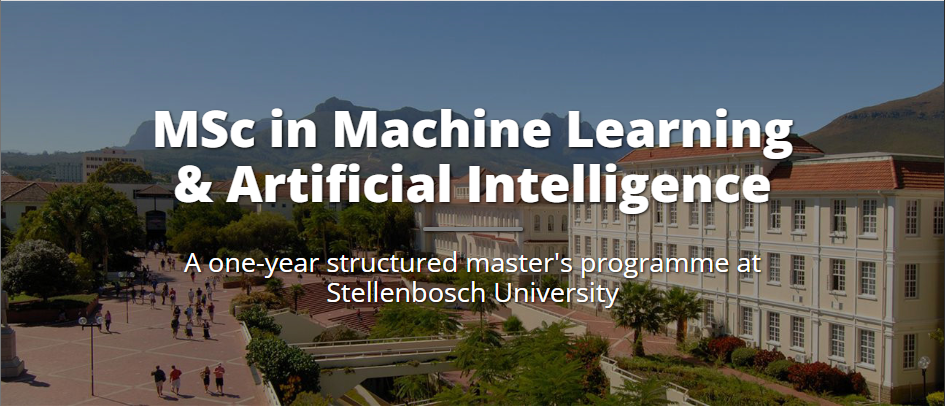
MSc in Machine Learning and Artificial Intelligence at Stellenbosch University 2027 — One of Africa’s Best AI Master’s Programmes
Artificial intelligence is reshaping every industry on the planet. The demand for professionals who genuinely understand machine learning, not just how to use tools built on it, but how to build, evaluate, and advance the underlying systems, has never been higher. And the supply of programmes that teach it rigorously, at a research frontier level, remains far smaller than the demand.
The MSc in Machine Learning and Artificial Intelligence at Stellenbosch University in South Africa is one of the most rigorous and well-structured AI master’s programmes available on the African continent, and increasingly, one worth comparing against equivalent programmes globally. It is a one-year, full-time, in-person programme that runs from January to December, combines foundational ML and AI theory with cutting-edge research-frontier techniques, and is delivered by one of Africa’s leading research universities.
Applications for the 2027 intake are open now.
This post covers everything you need to know: what the programme teaches, who it is designed for, why Stellenbosch, and how to apply.
What Is Stellenbosch University?
Stellenbosch University (SU) is one of South Africa’s oldest and most research-intensive universities, founded in 1918 and located in the town of Stellenbosch in the Western Cape, approximately 50 kilometres from Cape Town. It is consistently ranked among the top universities in Africa and has particular strength in the natural sciences, engineering, mathematics, and increasingly, computational and data sciences.
The university operates primarily in English and Afrikaans, with postgraduate programmes in most technical fields delivered entirely in English. The campus is located in one of the most beautiful settings of any university in the world — a historic town surrounded by mountains and vineyards, with direct access to Cape Town’s world-class infrastructure, international airport, and growing technology industry.
Stellenbosch’s investment in machine learning and AI research is real and growing. The MLAI programme sits within an institutional context that includes active research groups, industry partnerships, and a broader African technology ecosystem that is increasingly attracting global attention.
What the Programme Covers
The MSc in Machine Learning and Artificial Intelligence is explicitly designed for students with a strong mathematical and computational background. This is not a programme for beginners who want an introduction to AI concepts; it is a rigorous, research-level programme that assumes mathematical maturity and computational fluency from day one.
The programme delivers two things in combination:
The fundamentals of ML and AI. The theoretical and mathematical foundations of machine learning, probability theory, linear algebra, optimisation, statistical learning theory, neural network architectures, and the core algorithms that underlie modern AI systems. These are taught rigorously, not just applied through frameworks.
Sophisticated techniques and concepts at the research forefront. Beyond the fundamentals, the programme takes students to the current edge of the field, deep learning, reinforcement learning, probabilistic graphical models, generative models, natural language processing, computer vision, and the research questions that are actively being worked on by the global AI community.
The combination of foundational rigour and research-frontier coverage is what distinguishes strong AI programmes from vocational ones. Understanding why algorithms work, and where they fail, is what separates engineers who can adapt when the tools change from those who cannot.
The programme runs in-person on the Stellenbosch campus from January to December, a full calendar year of intensive study. This is not a distance learning or hybrid programme. You are on campus, in the environment, engaged with faculty and peers daily.
Who This Programme Is For
The programme is explicitly designed for students with a strong mathematical and computational background. Before applying, be honest with yourself about whether you meet this profile.
Strong candidates typically have:
A Bachelor’s degree in one of the following or closely related fields:
- Mathematics or Applied Mathematics
- Computer Science or Computer Engineering
- Electrical Engineering or Electronic Engineering
- Statistics or Data Science
- Physics or Computational Physics
- Any engineering discipline with strong mathematical content
Core mathematical preparation that the programme assumes:
- Linear algebra, matrix operations, eigendecomposition, singular value decomposition
- Calculus and multivariable calculus, gradients, partial derivatives, chain rule
- Probability and statistics, probability distributions, Bayes’ theorem, statistical inference
- Optimisation, gradient descent, convex optimisation basics
Programming experience:
- Python is the standard language for ML/AI research globally. Comfort with Python, NumPy, and ideally at least one ML framework (PyTorch or TensorFlow/JAX) is expected
- Experience with data manipulation and numerical computing
If your undergraduate background is primarily in social sciences, humanities, or business without substantial mathematical content, this programme is not the right starting point. The rigour is genuine and the programme does not teach undergraduate mathematics from scratch.
If you have the mathematical foundation and programming experience — and you want to understand AI at a level that goes beyond using pre-built tools — this programme is built for your ambitions.
Why Study AI in Africa, and Why Stellenbosch Specifically
This is a question worth answering honestly, because the answer matters for your career.
The African AI ecosystem is real and growing. Lagos, Nairobi, Cape Town, Accra, and Cairo are all developing active technology and AI communities. African AI researchers are publishing in top venues, building companies, and attracting international investment. Studying in this ecosystem, rather than being a visitor to it from abroad, gives you roots and networks in one of the world’s most dynamic emerging technology markets.
Stellenbosch’s research community is serious. The MLAI programme is built by researchers who are active at the international research frontier, publishing at top venues, collaborating with global institutions, and engaging with the real open questions in the field. The quality of faculty supervision and research exposure at a programme like this is not diminished by being in South Africa rather than Stanford or Oxford.
Cost of living is significantly lower than European or North American alternatives. Stellenbosch is an affordable place to live by the standards of any university town in Europe, the UK, or North America. The rand’s exchange rate means that for international students converting from stronger currencies, the cost of living is extremely manageable. This matters; a rigorous one-year programme in a livable, affordable environment with a strong research culture is a genuinely competitive proposition.
Cape Town access. Stellenbosch is 50 kilometres from Cape Town, one of the world’s most internationally connected and culturally rich cities, with a growing technology industry, direct flights to major international hubs, and a quality of life that consistently places it among the world’s most livable cities. This is not a provincial posting; it is one of the best-located university campuses in the world.
The African context adds research value. AI research that is grounded in African contexts, languages, datasets, infrastructure constraints, health systems, and agricultural challenges is increasingly important globally. Researchers who understand these contexts have a distinctive perspective that purely Western-trained AI professionals lack.
Funding and Scholarships for the MLAI Programme
The programme information provided does not detail specific scholarship offerings within the MLAI programme. However, several funding avenues are worth pursuing for international students considering this programme:
Stellenbosch University Postgraduate Bursaries: SU offers merit-based bursaries for postgraduate students. Check the university’s postgraduate funding office for current awards available to MLAI students — both domestic and international.
National Research Foundation (NRF) of South Africa: The NRF funds postgraduate students at South African universities, including international students in some funding streams. Eligible students should check nrf.ac.za for current opportunities.
African Development Bank Scholarships: The AfDB and its associated programmes fund African postgraduate students in STEM and technology fields. Check afdb.org for current opportunities.
DAAD In-Country/In-Region Scholarships: The German Academic Exchange Service funds African postgraduate students at African universities through its in-region scholarship programme. This is specifically designed for students who want to study at strong African institutions rather than leaving the continent. Check daad.de for current DAAD in-region opportunities at South African universities.
Google and Tech Industry Fellowships: Google, Microsoft, and other major technology companies run fellowship programmes for AI researchers from underrepresented regions. Google’s AI for Social Good programme and Microsoft Research’s AI for Health programme both fund researchers in this space.
Contact the MLAI programme directly at mlai.sun.ac.za for information on available bursaries and funding support specific to the programme, this is the most reliable source of current funding information.
How to Apply
Applications for the 2027 intake are currently open. The programme runs from January to December, meaning the 2027 cohort begins in January 2027.
Visit the official programme website: mlai.sun.ac.za
The programme website is the definitive source for application requirements, deadlines, and the application portal. Key items that a rigorous postgraduate programme application of this type typically requires:
- Academic transcripts from all previous institutions
- Proof of your highest qualification
- A statement of purpose or motivation letter explaining your background, your interest in ML/AI, and your research or career goals
- Academic references from supervisors or lecturers who can speak to your mathematical and computational ability
- Evidence of English language proficiency (for non-native English speakers)
- Programming portfolio or evidence of coding proficiency, where relevant
Apply early. One-year structured master’s programmes with rigorous entry requirements typically have limited cohort sizes, early applications receive earlier decisions, and avoid deadline-period congestion.
Career Outcomes: What an MLAI Master’s Opens Up
A rigorous master’s in machine learning and AI from a research-level programme positions you for a range of high-value careers in one of the fastest-growing fields in the global economy:
Machine Learning Engineer — building, training, and deploying ML systems at technology companies. Among the highest-paid engineering specialisations globally.
AI Researcher — conducting original research in academia, industrial labs (Google DeepMind, Meta AI, Microsoft Research), or government research institutions.
Data Scientist (Senior) — the ML/AI master’s distinguishes you from data scientists with generalist backgrounds, positioning you for senior roles with direct model development responsibility.
AI Product Manager — product leaders who understand the technical underpinnings of AI systems are in extremely high demand as companies build AI-native products.
Quantitative Analyst / AI in Finance — financial institutions are among the largest employers of ML specialists globally, applying these techniques to trading, risk, fraud detection, and portfolio management.
AI Policy and Ethics Researcher — as governments and institutions grapple with AI governance, researchers who understand both the technical and social dimensions of AI systems are increasingly valuable.
Entrepreneur / AI Startup Founder — the combination of research-level AI knowledge and the African market context is a strong foundation for building AI companies addressing African challenges.
Comparison: MLAI at Stellenbosch vs. Other AI Master’s Programmes
| Programme | Country | Duration | Mode | Focus |
|---|---|---|---|---|
| MSc MLAI — Stellenbosch | South Africa | 1 year | In-person | Rigorous ML/AI theory + research frontier |
| MSc AI — University of Edinburgh | UK | 1 year | In-person | Strong research focus, high global ranking |
| MSc Machine Learning — UCL | UK | 1 year | In-person | Research-intensive, London location |
| MSc CS (ML) — Carnegie Mellon | USA | 1.5 years | In-person | Top-ranked, extremely competitive |
| AMMI — AIMS Pan-Africa | Pan-Africa | 1 year | In-person | Africa-specific, high industry connection |
| MSc Data Science — University of Cape Town | South Africa | 1 year | In-person | Broader data science with ML components |
The Stellenbosch MLAI programme is positioned alongside the African Master’s in Machine Intelligence (AMMI), run by AIMS in partnership with Google DeepMind and Meta AI, as one of the strongest AI postgraduate programmes on the African continent. For students who want to study AI seriously in Africa rather than relocating to Europe or North America, these two programmes represent the clearest options.
Honest Assessment: Is This the Right Programme for You?
If you have the mathematical background, and this is the crucial qualifier, the MLAI programme at Stellenbosch is a genuinely rigorous, research-calibre programme in one of the most important fields in technology. It is taught by active researchers, located in a world-class environment, and positioned in a growing African technology ecosystem that gives your skills real-world application context.
The honest caveat: this programme will be demanding. The mathematical rigour is real. Students who come in without strong foundations in linear algebra, calculus, and probability will struggle. The one-year timeline is intensive — there is no time for catching up on undergraduate mathematics mid-programme.
If you have that foundation and you are genuinely driven by understanding AI at depth — not just using it — this is one of the best one-year AI master’s opportunities available in Africa, at a cost of living that makes the year genuinely sustainable.
Applications for 2027 are open. Visit mlai.sun.ac.za to begin.
FAQ
Is this programme open to international students? Yes. Stellenbosch University accepts international postgraduate students. Check the MLAI programme website and SU’s international admissions pages for specific requirements for your country.
Is the programme taught in English? Yes. The MLAI programme is delivered entirely in English.
Is it possible to do this programme part-time or online? No. The programme is full-time and in-person on the Stellenbosch campus from January to December. Distance or part-time options are not available.
What programming language does the programme use? Python is the standard language for ML/AI research. Familiarity with Python and numerical computing libraries (NumPy, PyTorch, etc.) is expected. Check the programme website for specific technical prerequisites.
Are scholarships available? The programme website at mlai.sun.ac.za is the best source of current funding information. External options include DAAD in-region scholarships, NRF bursaries, and technology company fellowships.
When does the 2027 programme start? January 2027. Applications are currently open.
What is the application deadline for 2027? Check mlai.sun.ac.za for the current application deadline; this is the definitive source for the 2027 intake timeline.
How competitive is admission? The programme requires a strong mathematical and computational background and has a limited cohort size. Early application is strongly recommended.
For more information and application:

