
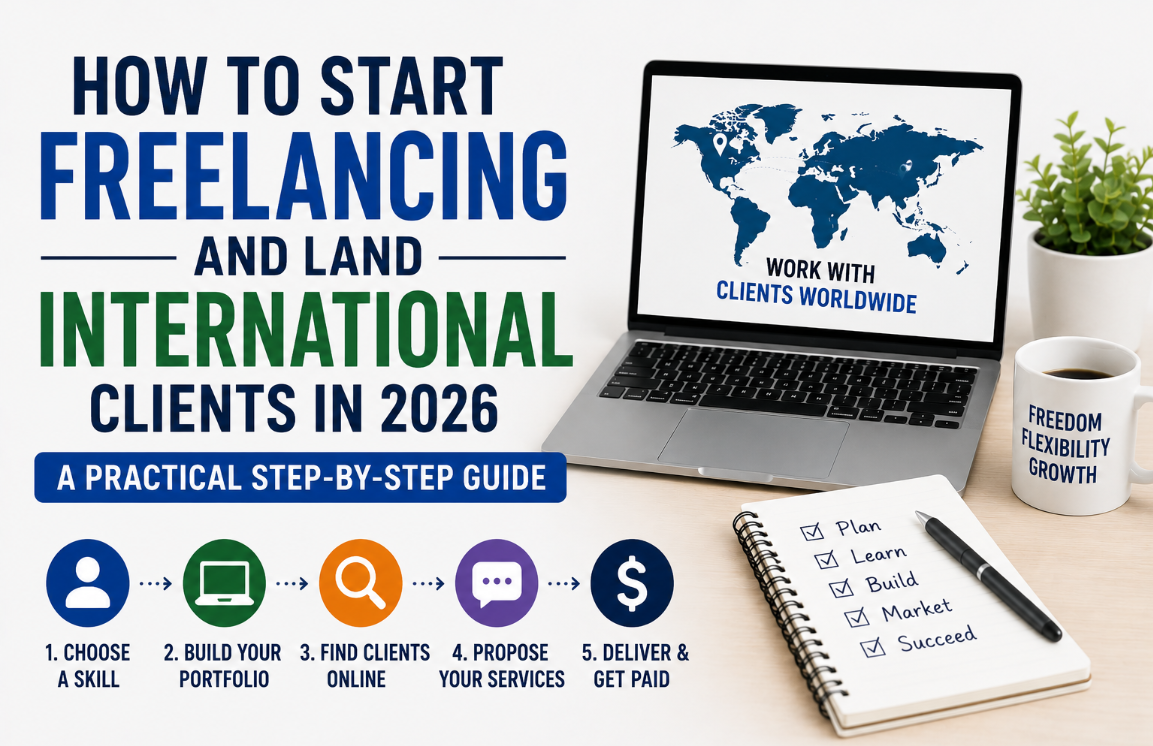
How to Start Freelancing and Land International Clients in 2026: A Practical Step-by-Step Guide
Freelancing is one of the most direct paths to earning in dollars from anywhere in the world. There is no HR process, no visa requirement, no employer to convince. You build a skill, position yourself clearly, find clients who need that skill, deliver excellent work, and get paid.
That is the simple version. The honest version is that getting your first international client requires more deliberate effort than most “start freelancing today” posts acknowledge. This guide gives you the real process.
Step 1: Choose One Skill and Go Deep
The single biggest mistake new freelancers make is trying to offer everything. “I do graphic design, social media, content writing, and video editing” is not a freelance business; it is a confused service catalogue that attracts no one in particular.
International clients, especially businesses with real budgets, hire specialists. They search for “email copywriter for SaaS companies,” or “Figma designer for mobile apps,” or “Facebook ads specialist for e-commerce.” They do not search for “general creative person.”
Pick one skill. The skill should ideally sit at the intersection of three things: something you are good at or can become good at quickly, something that has consistent demand from US businesses, and something you can demonstrate through a portfolio.
The highest-demand freelance skills for US clients in 2026:
- Copywriting and content writing — particularly for SaaS, tech, and e-commerce
- UX/UI design — product design, web design, mobile app design
- Web development — front-end, full-stack, WordPress, Webflow
- Paid advertising — Google Ads, Facebook/Meta Ads, LinkedIn Ads
- SEO and content strategy — particularly long-form SEO content
- Video editing — YouTube content, social media, corporate video
- Email marketing — Klaviyo, Mailchimp, campaign strategy, and execution
- Data analysis — SQL, Python, Excel, Tableau, Power BI
- Virtual assistance — executive support, operations, project coordination
Step 2: Build a Portfolio Before You Have Clients
The portfolio problem, you need work to show clients, but you need clients to get work, is solvable with deliberate effort.
Create spec work. Pick three companies you would love to work for and do the work for them without being hired. Design a better landing page for their product. Write a sample email sequence in their voice. Build a demo dashboard using publicly available data. This is not dishonest — it is initiative, and it produces real portfolio pieces.
Offer reduced-rate or pro-bono work to build your first case studies. Find two or three small businesses, charities, or startups that need your skill and offer to work with them at a significantly reduced rate in exchange for permission to document the project as a case study. A case study with a real client, real brief, real constraints, and a measurable outcome is worth ten times more than a personal project.
Document everything. A portfolio case study is not just the finished work — it is the problem, your process, your decisions, and the result. Write it up properly. Show your thinking.
Step 3: Build a Simple Professional Presence
You do not need a complex website to start freelancing. You need one page that clearly answers three questions: who you are, what you do, and how to hire you.
Minimum viable freelance presence:
- A clean, simple portfolio page — Notion, Carrd, or a basic WordPress site all work. Free options are fine to start.
- A LinkedIn profile optimised for your freelance skills headline, about section, and portfolio links updated
- An email address that is professional — firstname.lastname@gmail.com
Your portfolio page should include: a brief introduction, your specific service and who it is for, two to three portfolio case studies, and a clear contact method or booking link.
Step 4: Choose Your Client Acquisition Channel
There are four primary channels for finding US freelance clients. Each has different trade-offs. Start with one and master it before adding others.
Channel 1: Freelance Platforms (Upwork, Toptal, Contra)
Best for: Getting your first clients and building reviews
Upwork is the largest freelance marketplace globally. US businesses use it heavily to find vetted talent. The competition is real, but the access to paying clients is immediate once your profile is strong.
How to win on Upwork:
- Complete your profile to 100% — every section, every skill, a professional photo
- Specialise your profile around one clear service category
- Write proposals that address the client’s specific problem — not generic pitches
- Start with competitive but not dirt-cheap rates — very low rates attract bad clients
- Apply to five to ten jobs per day consistently until you land your first contract
- Deliver your first two or three projects exceptionally — reviews compound
Toptal is more selective (you go through a screening process) but pays significantly higher rates. If your skill level is strong, the Toptal application is worth the effort. Contra is commission-free and growing in the design and creative space.
Channel 2: Cold Email Outreach
Best for: Targeting specific companies or industries directly
Cold email is underused by freelancers outside the US, which means the inboxes of US business owners are less saturated with international outreach than you might think.
The process:
- Define your ideal client — company type, size, industry, and the specific problem your skill solves for them
- Find their contact information — LinkedIn, company websites, or tools like Hunter.io (free tier available) for email finding
- Write a short, specific cold email — two to three sentences maximum, focused on a specific problem you can solve for them, with a low-friction call to action (“Would it be worth a 15-minute call this week?”)
- Follow up once if no response after five to seven days
- Track everything in a simple spreadsheet
The key to cold email is specificity. “I help SaaS companies reduce churn through better onboarding email sequences — I noticed your onboarding flow has three potential drop-off points I could address.” gets a response. “I am a freelance email marketer looking for opportunities” does not.
Channel 3: LinkedIn Outreach
Best for: Building relationships with decision-makers before pitching
LinkedIn is the most professional social network in the US. Many small business owners, marketing managers, and startup founders who need freelancers are active on it daily.
The process:
- Optimise your LinkedIn profile for your freelance skills
- Search for your ideal clients by job title, company size, and industry
- Connect with a brief, non-pitchy note focused on them: “I noticed your company is scaling its content — happy to connect with other marketing-focused professionals.”
- Engage with their content authentically for one to two weeks
- After establishing a connection, send a brief message noting a specific problem you can help with and inviting a call
Do not pitch in your first connection request. Build the relationship first. US professionals respond well to genuine professional networking and poorly to immediate sales pitches from strangers.
Channel 4: Content and Inbound
Best for: Building a long-term pipeline on autopilot
Creating content that demonstrates your expertise, LinkedIn posts, a newsletter, a YouTube channel, and a blog builds a profile that attracts clients to you rather than requiring you to chase them.
This is the slowest channel to start, but the most scalable over time. A freelancer with 5,000 LinkedIn followers in their niche consistently receives inbound client inquiries. Getting to 5,000 takes six to twelve months of consistent posting — but the compound interest is real.
Step 5: Price Yourself Correctly
Underpricing is the most common mistake new freelancers make when targeting US clients, and it attracts the worst clients.
US businesses have expectations anchored to US market rates. A freelance web designer charging $5 per hour signals to a US business owner that there is a quality problem. It does not signal value. It signals desperation.
Research market rates for your skill on Glassdoor, Upwork’s rate transparency, and LinkedIn Salary insights. Price yourself at the lower end of the market range for your skill level, not below the market floor.
As a rough guide for entry-level freelance rates targeting US clients in 2026:
- Copywriting: $0.10–$0.25 per word or $30–$75 per hour
- UX/UI design: $35–$75 per hour
- Web development: $40–$80 per hour
- Social media management: $500–$1,500 per month retainer
- Paid advertising management: 10–15% of ad spend or $500–$2,000 per month
- Virtual assistance: $15–$35 per hour
These are entry-level starting ranges. Strong portfolios and specialisation command significantly higher rates.
Step 6: Deliver, Follow Up, and Ask for Referrals
Your first US client is the hardest to get. Your second is easier, because your first client is a reference, a case study, and potentially a referral source.
Deliver every piece of work at a higher standard than the client expected. Communicate proactively throughout the project. Meet every deadline. Send a follow-up message after delivery asking whether they are satisfied and whether they know anyone else who might benefit from your work.
The freelance referral network, US business owners recommending good freelancers to their peers, is one of the most powerful client acquisition channels available, and it is entirely free.
How to Receive Payment From US Clients
Once you land clients, you need a reliable way to receive USD. See our detailed guide: 👉 Best Ways to Receive USD Payments from International Clients in 2026
Short version: Wise, Payoneer, or Grey for Nigerian readers are your best options.
FAQ
How long does it take to get a first US freelance client? With consistent daily effort, applying on Upwork, sending cold emails, or posting on LinkedIn, most people land a first client within four to eight weeks. Passive approaches take significantly longer.
Do I need to register a business to freelance for US clients? Not immediately. You can freelance as an individual initially. As your income grows, consult a local accountant about the right business structure and tax obligations in your country.
Can I freelance while working a full-time job? Yes, most freelancers start this way. Be aware of any exclusivity clauses in your employment contract and manage your time carefully to avoid quality problems on either side.

