
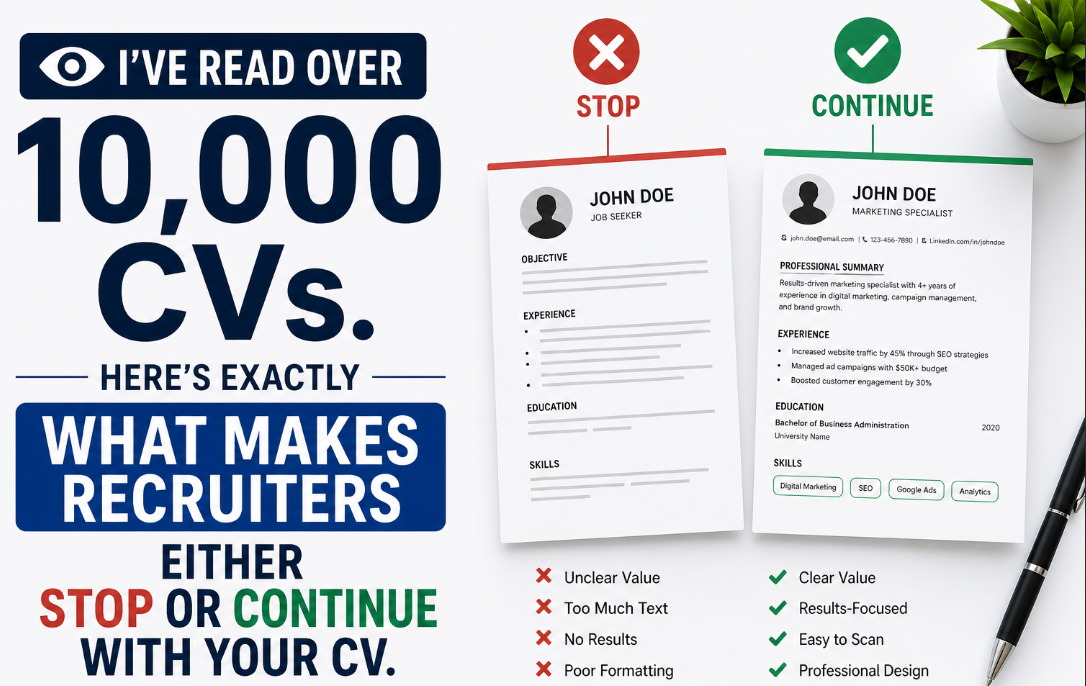
I’ve Read Over 10,000 CVs. Here’s Exactly What Makes Recruiters Either Stop or Continue With Your CV
I want to tell you something that most recruiters will not say out loud.
When I open a new batch of applications, I am not hoping to find reasons to hire people. I am looking for reasons to move forward quickly. In six years of recruiting across 35 countries, I have reviewed well over 10,000 CVs. And in that time, I have learned something that most job seekers never hear directly: the majority of CVs are rejected in under 30 seconds, not because the person is unqualified, but because the CV made it too hard to see that they were qualified.
This post is my attempt to fix that, from the inside out.
What I Am Actually Doing in Those 30 Seconds
Let me walk you through exactly what happens when your CV lands in my inbox.
I open the file. The first thing I notice, before I read a single word, is the layout. Is it clean? Can I see clear sections? Is the font readable? If the formatting is chaotic, has multiple columns that make scanning difficult, or looks like someone used a creative template that prioritised design over legibility, I am already forming a negative impression before I have read anything.
Then I scan, I do not read. I look at four things in this order:
- Your name and contact details: Are they clear and at the top?
- Your most recent job title and employer: Does this person have relevant experience?
- The bullet points under their most recent role: What did they actually do?
- The skills section: Do I see the tools and competencies this role requires?
If any of these four stops is confusing, unclear, or missing, I slow down. If slowing down reveals more problems, I move on. If they are all clean and compelling, I read more carefully.
That is the 30 seconds. Everything you put on your CV needs to survive this scan.
The Things That Make Me Stop: In a Good Way
Over thousands of CVs, certain things have consistently caught my attention. Here is what genuinely works:
Specific numbers in bullet points. When I read “Managed a portfolio of 65 SME clients, reducing churn by 28% over 12 months,” I stop. That bullet is doing real work; it tells me what you did, at what scale, and what resulted. I highlight it. I remember it. Compare that to “Responsible for managing client accounts,” I do not stop. I move on.
A professional summary that tells me something. I do not want to read “Hardworking and motivated professional seeking a challenging role.” I want to read “Customer success professional with 3 years in B2B SaaS, specialising in onboarding and retention for mid-market accounts. Currently targeting remote CS roles at product-led growth companies.” That second version tells me immediately whether this person is worth calling.
Relevant keywords in the right places. If my job description mentions Zendesk, Salesforce, and customer onboarding, and your CV does not mention any of these, even though you have used them, I may not shortlist you. Not because you lack the skill, but because my search and my scan did not find it. Use the language from the job description where it honestly reflects your experience.
Clean, single-column formatting. I can scan a single-column CV in seconds. Multi-column CVs, particularly those with sidebars, require me to jump around the page. In a high-volume screening session, anything that requires extra effort loses.
The Things That Make Me Move On: Every Time
These are the patterns that I have seen thousands of times and that consistently result in a CV going into the no pile:
The objective statement. “I am a hardworking, dedicated, and motivated professional seeking an opportunity to grow and contribute my skills to a dynamic organisation.” I have read some version of this sentence more times than I can count. It tells me nothing. It wastes the prime real estate at the top of your CV. Replace it with a professional summary that is specific to you and this role.
Bullet points that describe duties, not achievements. “Responsible for customer support,” “Assisted with marketing campaigns,” “Helped manage social media accounts”, these are job descriptions, not evidence of your impact. Every bullet on your CV should answer the question: “What did this person do, and what happened as a result?”
A CV that is too long for the experience level. When a recent graduate sends me a two-page CV, I know immediately that they have not edited carefully. One page for less than five years of experience. Two pages maximum for more than five. Anything longer signals poor judgment about what is relevant.
Personal information that does not belong. Date of birth, marital status, religion, nationality, a passport photo, these are not relevant to your ability to do the job, and including them can expose you to the exact biases you want to avoid. International employers, especially in the US and UK, do not want this information and sometimes flag CVs that include it.
References available on request. This line takes up space and tells me nothing. Of course, you have references. Everyone does. Remove it.
An email address that is not professional. I once received a CV from “partytime247@…” for a senior finance role. I moved on.
The Specific Fixes That Make the Biggest Difference
I have seen candidates transform their callback rate by making three specific changes. Here they are:
Fix your bullet points first. Go through every bullet point on your CV and ask: Does this tell the reader what I did, at what scale, and what resulted? If not, rewrite it using the formula: Action verb + what you did + result or scale. “Resolved customer support tickets” becomes “Resolved an average of 50 customer support tickets daily via Zendesk, maintaining a 94% satisfaction score across 12 months.”
Replace your objective statement with a two-line professional summary. Write it in this format: [What you are professionally] with [X years] of experience in [your core skill area]. Seeking a [type of role] at [type of company]. That is it. Two lines. Specific. Readable in three seconds.
Check your CV for the keywords in the job description. Open the job description. Find the skills, tools, and responsibilities mentioned. Check whether your CV uses the same language that honestly reflects your experience. If you use Salesforce but your CV says “CRM software,” change it to Salesforce. This is not gaming the system — it is speaking the recruiter’s language.
What I Want to See More Of
In six years of recruiting, the CVs that stand out are not always from the most experienced candidates. They are from candidates who clearly understand the reader’s perspective, who have thought about what a recruiter is looking for, and structured their CV to answer that question efficiently.
The best CV I ever saw was from a candidate with three years of experience applying for a mid-level customer success role. It was one page, clean single column, with a crisp two-line summary, four roles each with three to four specific bullet points with numbers, a skills section that mirrored our job description, and two relevant certifications. I called them within 20 minutes of opening it.
That is what I want to see. And it is within reach for anyone willing to edit their CV with the reader in mind.
Related Posts: Apply What You Just Learned
- How to Write a CV That Gets You a Remote Job in 2026 — With a Free Template
- How to Write a Cover Letter for a Remote Job in 2026
- How to Answer the Most Common Interview Questions in 2026
- LinkedIn Profile Tips for Getting Hired Internationally
And when your CV is ready — apply here: 👉 jobs.iammagnus.com/jobs
FAQ
How long should my CV actually be? One page for less than five years of experience. Two pages maximum for five to ten years. If you have more than ten years of experience, two pages is still the goal — focus on the most recent and most relevant roles.
Should I use a template? A simple, clean template is fine. Avoid heavily designed templates with columns, sidebars, or graphics; these often confuse applicant tracking systems and make it harder for recruiters to scan. Google Docs has free, clean templates that work well.
What font should I use? Arial, Calibri, or Georgia at 10–11pt for body text. Clean, readable, professional. Avoid Times New Roman and any decorative fonts.
Is it okay to have gaps in my CV? Yes, gaps happen. Do not try to hide them with creative date formatting. Be prepared to address them honestly in an interview. Unexplained gaps are noticed; honestly explained gaps are not disqualifying.
Do I really need to tailor my CV for every job? You need to tailor your professional summary and skills section for each application. The rest of your CV stays the same. A CV that was clearly written for a different role is worse than no customisation at all.

